A photonic chip sends thousands of light beams into space at the same time. This could support displays, LiDAR, 3D printers, and quantum computers.
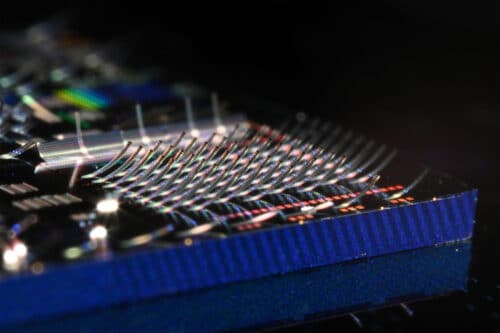
Researchers at Massachusetts Institute of Technology (MIT) have developed a photonic chip that can broadcast light from thousands of points on a chip into free space. The approach could support displays, LiDAR systems, 3D printers, and quantum computers.
The chip contains an array of structures that curve upward from the surface and emit laser beams outward. These structures allow light to be directed from many points on the chip at the same time.
The new device guides light through optical waveguides toward the curved emitters. Integrated modulators control when the light turns on and off, allowing the system to project and move patterns of light in free space.
The curved emitters are created using a two-layer structure made from different materials. When the chip cools after fabrication, the materials contract at different rates. The difference in strain causes the structures to bend upward, forming the light-emitting ramps. The mechanism is similar to the way thermostats bend when two materials expand at different rates.

The system can also emit light in different colors. By adjusting the frequency of the light, the density of the projected pattern can be changed, allowing the chip to create images or optical patterns.
The technology also addresses a challenge in quantum computing systems based on diamond qubits controlled by laser beams. Future systems may require control of millions of qubits at once. Managing a laser beam for each qubit would be difficult, creating the need for a method that can broadcast and steer many beams across a large area.
Most approaches that direct light from photonic chips into free space can handle only a small number of beams and do not scale well for large quantum systems. The new platform is designed to emit thousands of beams at the same time.
Beyond quantum computing, the approach could enable LiDAR units for robotic platforms and support laser-based 3D printing systems that build objects by curing layers of resin.
Future work will focus on scaling the platform, studying the uniformity and manufacturing yield of the curved emitters, integrating arrays of photonic chips, and testing device durability. The technology could also support lab-on-chip tools and micro-scale optical robotic systems.