

New robotics research enables machines to manipulate irregular objects such as fruits and tools by mapping their surface geometry, unlocking more adaptive automation for electronics-driven robotic systems in real-world environments.
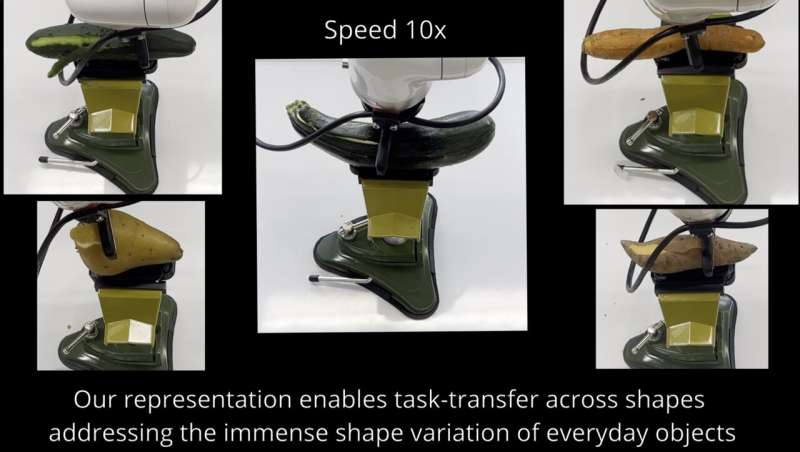
Robotics researchers at the Swiss Federal Institute of Technology Lausanne (EPFL) and the Idiap Research Institute have taken a major step toward enabling machines to handle everyday objects with human-like adaptability, solving a long-standing challenge in automation. A new system allows robots to manipulate irregular shapes—such as bananas, cups, and peelers—by understanding their geometry rather than relying on fixed instructions.

The edge comes from a collaboration between EPFL and the Idiap Research Institute, in which scientists developed a geometry-aware framework that helps robots adapt to objects with varying curvature and structure. Unlike traditional systems that struggle beyond simple shapes like boxes, the new approach enables robots to generalise skills across different objects without retraining.
At the core of the system is a stereo vision setup that captures a 3D representation of an object. This data is converted into a point cloud—a digital map of the object’s surface—which the robot uses to determine how to move and interact with it in real time. By continuously updating its motion based on this geometric map, the robot can perform tasks such as peeling, slicing, or cleaning on unfamiliar objects.
A key innovation lies in task transfer. Once the robot learns a manipulation skill on one object, it can apply the same logic to another with a completely different shape. This significantly reduces the need for repeated programming, a major bottleneck in robotics deployment.

In testing, the system demonstrated strong robustness, even when sensor data was incomplete or noisy. A mathematical smoothing process helps compensate for gaps in the 3D model, ensuring stable operation in real-world conditions where perfect data is rarely available.
From an electronics and systems perspective, the research advances perception-driven robotics. By integrating vision sensors, spatial computation, and adaptive control, the approach moves robots closer to handling unstructured environments such as kitchens, factories, and healthcare settings.
However, limitations remain. The current system still depends on manually labelled key points on objects before execution, and researchers aim to automate this step in future iterations. They also plan to extend the method to soft and deformable objects, which introduce additional complexity.
The development signals a shift toward more flexible robotic systems—where understanding shape replaces rigid programming—bringing machines closer to performing nuanced, real-world tasks with minimal human intervention.