

A perovskite device that works as both a high-efficiency solar cell and an LED, opening new possibilities for self-powered displays, smart windows and multifunction electronics.
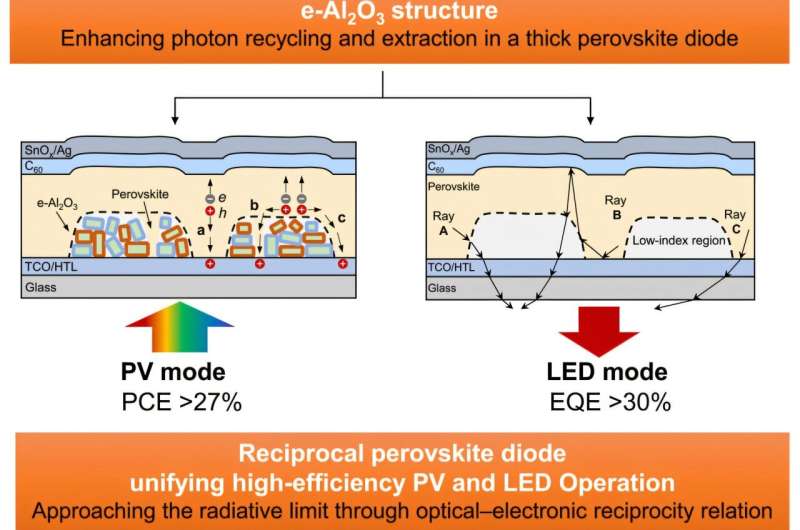
A new advancement in electronics materials could merge two major technologies—solar power generation and light emission—into a single device. Researchers at the University of Colorado at Boulder have demonstrated a metal-halide perovskite component that functions efficiently as both a solar cell and a light-emitting diode (LED), overcoming a long-standing design conflict between the two applications.
Perovskites have attracted significant industry attention for next-generation electronics because they are cheaper to produce than many conventional semiconductors and offer strong light absorption and tunable emission properties. Until now, however, perovskite-based solar cells and LEDs have been engineered separately because each requires a very different material thickness and surface structure.
Solar cells typically need a relatively thick perovskite layer to capture enough incoming sunlight and convert it into electricity. LEDs, in contrast, perform better with ultra-thin and slightly uneven films that help photons escape the device. These opposing requirements have limited attempts to combine both functions into a single practical architecture.
The research team resolved this by redesigning the perovskite layer structure to support efficient charge transport and improve optical performance in both operating modes. The result is a dual-function device that absorbs light efficiently for power generation and emits light effectively when switched to LED mode.
The development could lead to displays that recharge themselves under ambient light, reducing energy consumption in portable electronics. It may also enable smart windows that harvest solar energy during the day and provide illumination at night, or sensors and wearables that integrate energy harvesting with optical signalling into a single compact component.
In the electronics sector, the innovation highlights how multifunction semiconductor design is becoming a key trend. Instead of using separate chips or modules for power and lighting, future devices may combine several capabilities into a single thin-film layer, reducing size, cost, and system complexity.