A wearable device uses rings and AI to translate sign language into speech in real time, offering an alternative to sensor gloves for communication.
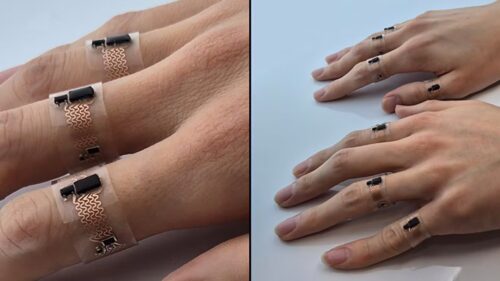
Researchers at Yonsei University have developed a wearable sign language translation system that uses wireless rings instead of sensor gloves, allowing sign language gestures to be converted into speech in real time with nearly 90 percent accuracy.
The system, called the wirelessly connected ring-type sign language translator (WRSLT), is designed to address one of the limitations of existing sign language translation technology: practicality. Many current systems rely on gloves fitted with wired sensors or camera-based tracking setups that can be restrictive or unsuitable for everyday use.
The new approach replaces gloves with sensor rings worn on selected fingers. Each ring contains an accelerometer that tracks finger movement and hand orientation. Gesture data is transmitted wirelessly to an artificial intelligence system that interprets the signs and converts them into spoken language.
The researchers focused on making the device comfortable for long-term wear. Glove-based systems can limit hand movement and often struggle to accommodate different hand sizes and finger shapes. Because the WRSLT rings operate independently and are not physically connected, users can position them more freely, improving comfort and flexibility during signing.
To reduce hardware complexity, the team analyzed which fingers contributed most to sign recognition. Their findings showed that seven key fingers provided the strongest signals for classification, allowing the system to maintain performance while using fewer sensors.
The device was trained to recognize both American Sign Language and International Sign Language. In testing with users who were not included in the training data, the system achieved recognition accuracies of 88.3 percent for American Sign Language and 88.5 percent for International Sign Language. The ability to maintain accuracy with previously unseen users suggests the technology can generalize without requiring personalized recalibration.
The researchers also developed a sequential word detection framework that enables the system to process continuous signing rather than isolated gestures. Instead of requiring pauses between words, the translator can interpret connected streams of signing and generate sentence-level output in real time.
The researchers believe the technology could eventually be adapted into a commercial device for daily use, potentially improving accessibility and communication for people who rely on sign language.