




Accelerate ADAS development with a 77 GHz radar platform supporting real-time sensing, object detection, prototyping, and radar integration for automotive applications.
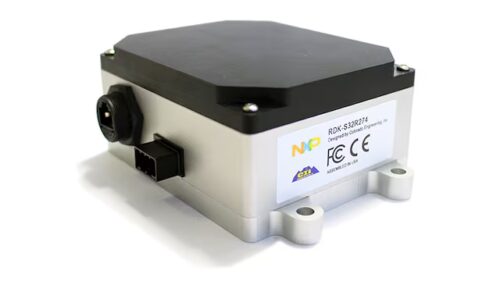
The Automotive Radar Reference Platform from NXP Semiconductor is a complete 77 GHz radar development solution designed to help design engineers accelerate the development and deployment of advanced driver assistance systems (ADAS). Built to support modern automotive radar applications, the platform combines radar processing, RF integration, safety-oriented power architecture, and software development tools into a scalable environment for rapid prototyping and evaluation. It enables engineering teams to reduce development complexity while improving the speed of radar algorithm validation and system integration.
The platform is optimized for automotive applications such as Adaptive Cruise Control (ACC), Automatic Emergency Braking (AEB), collision avoidance, blind spot detection, occupancy sensing, and target tracking. By integrating processing, transceiver functionality, antenna support, and communication interfaces into a unified reference architecture, the solution allows engineers to focus on application development rather than low-level hardware integration challenges. This approach significantly shortens development cycles for automotive radar systems and enables faster transition from evaluation to production-oriented designs.
Designed using automotive-grade development methodologies, the reference platform supports functional safety-oriented development workflows targeting ISO 26262 ASIL B requirements. The architecture enables engineers to evaluate radar performance in realistic operating conditions while maintaining flexibility for customization and future scalability. The modular hardware design also supports different antenna configurations and radar topologies, making the platform suitable for front radar, corner radar, and other advanced sensing applications.
The radar platform supports advanced signal processing techniques such as MIMO processing, digital beamforming, and steerable beam architectures. These capabilities help improve object detection accuracy, range resolution, angular precision, and tracking reliability in complex driving environments. Engineers can use the platform to evaluate radar behavior under dynamic traffic scenarios and optimize algorithms for vehicle detection, pedestrian sensing, and obstacle classification. The inclusion of real-time processing and data visualization tools further simplifies system debugging and performance tuning.
To accelerate software development, the platform includes an integrated software ecosystem with demonstration applications, radar configuration tools, and graphical visualization support. Engineers can capture and analyze radar data in real time, modify chirp configurations, and evaluate signal processing performance through an Ethernet-based interface. The development environment also supports MATLAB-based experimentation, allowing algorithm developers to perform rapid signal analysis, waveform optimization, and data interpretation during the prototyping phase.
Another key advantage of the platform is its ability to simplify radar system validation and integration. By providing a pre-integrated hardware and software framework, the solution minimizes compatibility issues and reduces the engineering effort typically required for standalone radar development. Development teams can use the platform to accelerate proof-of-concept creation, evaluate system-level performance, and validate radar functionality before moving into custom hardware implementation.
NXP Semiconductor has tested this reference design. It comes with a bill of materials (BOM), schematics, assembly drawing, printed circuit board (PCB) layout, and more. The company’s website has additional data about the reference design. To read more about this reference design, click here.