Module delivers high-resolution depth sensing, fast frame rates, and AI-ready output, enabling advanced robotics, automation, healthcare, smart buildings, and immersive applications.
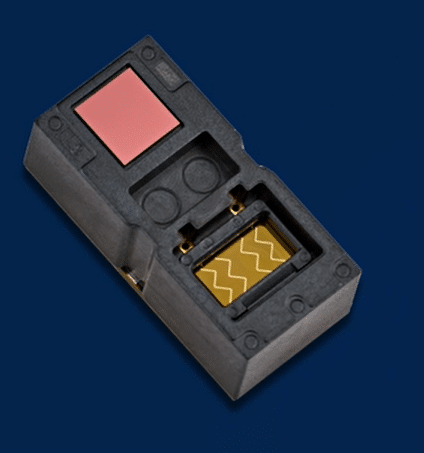
A new direct Time-of-Flight (dToF) 3D LiDAR module is targeting compact edge AI systems by combining high-resolution depth sensing, integrated processing, and long-range measurement in a single package. The STMicroelectronics FlightSense VL53L9 module is designed to simplify the deployment of spatial awareness in applications ranging from robotics and industrial automation to smart buildings, healthcare, and AR/VR devices.
The VL53L9 delivers a 2,268-zone (54 × 42) depth map, making it the highest-resolution all-in-one dToF LiDAR module in the company’s portfolio. It captures depth information at up to 100 frames per second and measures distances from less than 5cm to 9m, enabling accurate detection of small objects, contours, and edges. The wide 54° × 42° field of view further improves scene coverage for autonomous and interactive systems.
The key features are:
- Class 1 laser-safe design for user-safe operation.
- Calibration-free architecture reduces manufacturing effort.
- Dual power supply support (1.2V and 3.3V).
- Compatible with multiple cover glass materials for flexible product design.
- Dedicated on-chip power management IC minimises external components.
Built around ST’s stacked backside-illuminated SPAD sensor technology and metasurface optical elements, the module combines depth sensing with integrated on-chip processing to generate AI-ready data. Unlike conventional dot-scanning approaches, it uses a dual-scan flood illumination architecture that minimises motion artefacts, eliminates dead zones, and improves detection of fine objects while simultaneously capturing complementary 2D infrared and 3D depth information. This reduces post-processing requirements, allowing edge AI algorithms to run efficiently on resource-constrained microcontrollers.
The module integrates the dToF processing engine, power management circuitry, and factory calibration within a single compact package measuring 12.8mm × 6.1mm × 4.6mm, reducing design complexity and board space. It supports both MIPI and I3C interfaces, making it compatible with a wide range of embedded processors and system architectures.
The sensor addresses diverse industrial and commercial applications. In robotics, it supports simultaneous localisation and mapping (SLAM), obstacle avoidance, and small-object detection. Industrial automation systems can use it for volume measurement in tanks and storage bins. Smart building applications include privacy-preserving people counting and occupancy detection, while AR/VR devices benefit from gesture recognition, body tracking, and finger-skeleton tracking. Healthcare systems can leverage the depth sensor for fall detection and patient monitoring.