




An antenna improves wireless signals and data speeds across a range of frequencies without using extra power. The approach could support future communication networks and services.
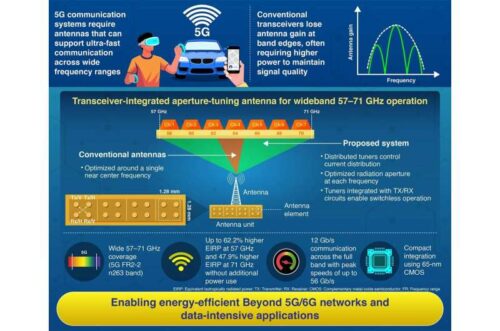
Researchers at the Institute of Science Tokyo have developed an aperture-adjustable antenna that improves wireless communication performance across the 57–71 GHz 5G millimeter-wave band without increasing power consumption. The system improved signal strength by up to 62.2% at 57 GHz and 47.9% at 71 GHz and achieved data transmission speeds of up to 56 Gb/s, making it suitable for Beyond 5G and 6G applications such as XR and other data-intensive services.
The technology combines a 60-GHz-band antenna with an integrated transceiver that adjusts the antenna’s radiation aperture based on operating frequency. By modifying current distribution inside the antenna, the system maintains performance across the entire 57–71 GHz frequency range, addressing a challenge in wideband millimeter-wave communications.
According to the researchers, conventional wireless systems are typically optimized for a central frequency and often experience reduced antenna gain and efficiency near the edges of a wide operating band. Maintaining communication quality in these conditions generally requires higher transmit power, increasing energy consumption.
To address this limitation, the team developed an aperture-tuning approach that focuses on optimizing signal radiation rather than relying only on impedance tuning. While impedance tuning improves power transfer into the antenna over a limited frequency range, aperture tuning adjusts current flow within the antenna structure to improve performance across a wider bandwidth.
The antenna and transceiver were fabricated using a standard 65-nanometer CMOS process. The design integrates multiple tuners into the transmitter and receiver matching circuits and uses a cross-active tuning architecture that eliminates the need for additional switching hardware. During transmission, receiver-side tuners adjust antenna radiation characteristics, while the arrangement is reversed during reception, helping reduce circuit complexity and save space.
Demand for faster wireless communication continues to grow as applications such as video streaming, cloud computing, smart devices, digital twins, virtual environments, and XR require higher data rates. The researchers say the antenna system could be integrated into 5G base stations, user devices, and future 6G infrastructure to make more efficient use of available millimeter-wave bandwidth.


