

Engineers at the European Space Agency’s (ESA’s) robotic arm, equipped with cameras, sensors, and onboard electronics, have similar motion to the human arm and are expected to play a key role in future moon missions.
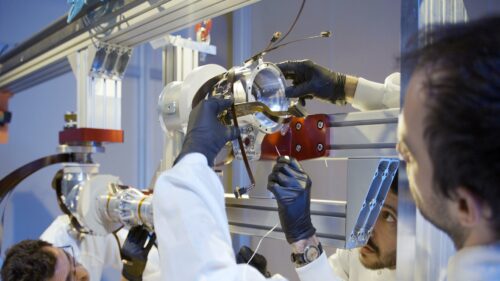
Engineers at the European Space Agency (ESA) are assembling a robotic system called Sample Transfer Arm (STA), designed to handle samples and perform complex tasks during future missions to the Moon and Mars.
The robotic arm can extend up to 2.4 metres, and it features seven degrees of freedom for creating similar motions to a human arm. The system is packed with cameras, sensors, and onboard electronics that allow it to perform tasks with a high level of autonomy.
The STA was originally developed as part of the joint NASA-ESA Mars Sample Return campaign, where it was intended to transfer Martian samples collected by NASA’s Perseverance rover for eventual return to Earth.
The arm features a human-arm-like configuration, consisting of a shoulder, elbow, wrist and a gripper at the tip with millimetre-level precision, and this precision could be useful for a variety of activities in space, including collecting geological samples, transferring equipment, and supporting astronauts during surface missions.

The system is also embedded with a number of sensors for different purposes, like force and torque sensors to measure how an object is being pushed, pulled, or twisted in three-dimensional space, allowing the arm to manipulate with greater accuracy, and position sensors for precise controls.
The arm is currently undergoing testing and integration to evaluate its performance. The system incorporates a flexible wrist mechanism, a flat electrical harness and a structural mechanism to withstand the forces encountered during launch and landing. ESA views advanced robotics as a key technology for future Moon exploration and eventually missions to Mars. The arm’s ability to see, feel, and manipulate supports sample handling and scientific operations beyond Earth.