

The new electrolyte boosts solid-state battery performance and lifespan by improving lithium-ion transport and structural stability.
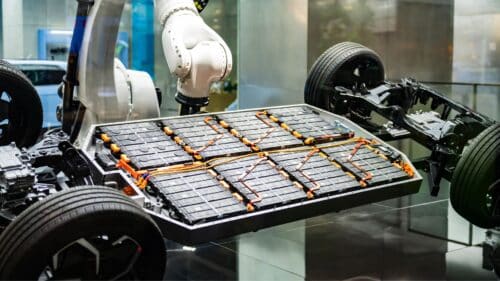
Scientists at the Dalian Institute of Chemical Physics have developed a solid-state battery electrolyte. This new electrolyte is supposed to make the batteries work better and last longer. They developed an organic-inorganic composite electrolyte that allowed a solid-state battery to retain over 84 per cent of its original capacity after 350 charge-discharge cycles.
The research team developed a composite electrolyte based on polyvinylidene fluoride (PVDF) and lithium oxychloride (Li₃OCl). To overcome the limitation of interface between the electrolyte and electrode, the researchers incorporated lithium oxychloride into the electrolyte. This led to an in-situ chemical reconstruction process that strengthened the bond and improved battery efficiency.
The tests showed that the electrolyte exhibited high lithium-ion transportation. It is also very stable and strong. The battery kept working even after many times of charging and using it. The solid-state battery with the electrolyte still worked at 84.2 per cent after 350 times of charging and using it.
Solid-state batteries are a type of battery that uses solid materials instead of flammable liquid, and that makes them higher energy density, charge faster, improve safety and less likely to overheat. There are some drawbacks with solid-state batteries. They have low ionic conductivity, manufacturing complexity and are also expensive.

The newly developed electrolyte aims to address several of these issues by enhancing ion transport while maintaining structural stability. The new electrolyte is still being tested. It is a good step towards making solid-state batteries that work well and are safe.
While large scale commercialisation of solid-state batteries is unlikely before 2030. The new electrolyte design offers a promising approach to overcome the challenges. Such technologies could help accelerate the adoption of safer and high-performance solid-state batteries in future electric cars.