

The new bird inspired robot stays stable in midair by automatically correcting its balance during flight.
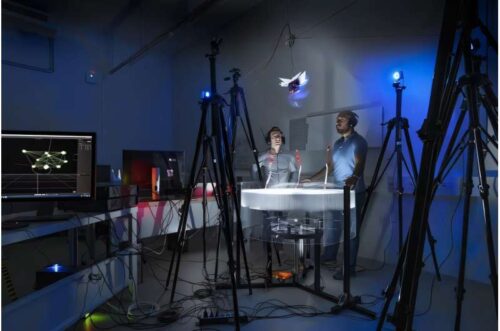
Scientists from the Max Planck Institute for Intelligent Systems in Tübingen and the University of Stuttgart have developed Floaty, a shape-changing aerial robot that combines efficient flight with the ability to remain stable in the air.
Floaty is inspired by birds, it stays in the air by making use of rising wind currents instead of propellers. The robot uses four movable flaps on the top, it helps in changing position to control how air flows around it. This allows Floaty to adjust its air resistance and maintain balance while flying.
During the wind tunnel tests with wind speeds up to 10 metres per second, the robot showed it can stay flying and adjust to changing wind conditions. It uses a learned aerodynamic model to keep balanced and hover steady. Even when the air pushes sideways, it can get stable fast without using a lot of power.
“We believe our work opens up new ways of building flying robots that are more efficient and more sustainable,” says Ghadeer Elmkaiel, who is first author of the publication and a Ph.D. student in the Learning and Dynamical Systems Group at MPI-IS. “Instead of relying on thrust-generating motors, Floaty shows that robots can ride the wind intelligently, just like birds—saving a lot of energy while still staying controllable.”
The biggest challenge faced was making the robot stable in flight so it wouldn’t flip over while ensuring it was easy to control. Early wind tunnel tests showed that Floaty’s flat design caused it to tip sideways instead of recovering its balance. To solve this, the researchers lowered the robot’s centre of gravity and modified its rigid flap with a carefully designed bend. These improvements lead to automatically regaining balance while flying.
Michael Mühlebach, who leads the Learning and Dynamical Systems Group and is co-author of the publication. He gives several examples: “Floaty could inspect factory smokestacks where there is strong upward airflow. It could potentially work there with little modification. Similar technology could perhaps also help control rockets during reentry, or it could help guide weather balloons. There are many ways in which the robot can take advantage of upward airflows to save energy.”