




A new wearable robotic system eases factory lifting through adaptive collaborative assistance.
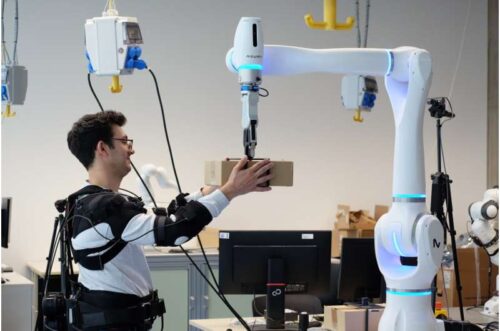
Researchers at the Technical University of Munich (TUM) have developed WearaCob (short for “wearable” and “collaborative”), which consists of a wearable upper-body exoskeleton and a single-arm collaborative robot (cobot) to reduce the physical strain on factory workers during lifting tasks. This method of safe collaboration between humans and robots will reduce physical strain by up to 65 per cent and improve production processes.
“This can be physically demanding, for example, during quality inspections of components that have to be repeatedly lifted and set down,” says researcher Federico Masiero from the Chair of Intelligent Bio-Robotic Systems at the TUM School of Computation, Information and Technology.
Conventional factory robots can work only with barriers that separate workers from the machines. However, in contrast, the WearaCob system allows workers to interact safely with robots. The exoskeleton looks similar to a backpack with an electric motor installed at the back that pulls cables over the shoulders to elbow pads. When the cobot lifts an object, it calculates the weight and wirelessly sends information about it to the exoskeleton, which helps to lift something in proportion to its weight. The robot also calculates the centre of mass, making it possible to handle asymmetrical components .
“We were able to demonstrate not only that we can specifically ease the physical workload of factory workers, but also how easy it is to teach the cobot new tasks,” explains Prof. Masia. “We can program it by guiding the robotic arm. Not a single line of code is needed. That’s a huge advantage over many robots currently used in factories, which operate behind safety barriers and away from human workers.”
The shoulder exoskeleton can also work independently; it uses the conventional method of measuring upper arm muscle activity to determine the required level of assistance. While this approach has an error margin of 0.5 – 1 kg. This approach requires a sensor to be attached to the wearer’s upper arm before every use, making it impractical for factory use The single-arm robot, which is a seven-joint cobot, is mobile and flexible, and the capability of autonomous slowing down when approaching a person adds to the safety.


