

Researchers have identified a hidden electronic state that emerges before superconductivity, offering fresh insights into how resistance-free electricity develops in quantum materials.
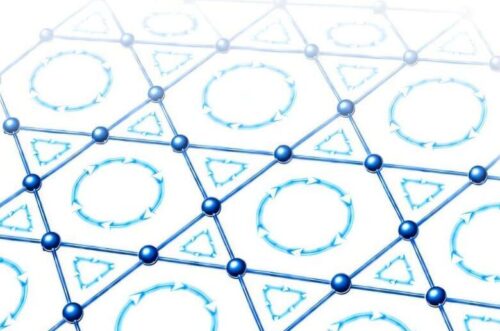
Scientists from the Korea Advanced Institute of Science and Technology (KAIST) have discovered an elusive electronic state that emerges before superconductivity in the kagome metal CsV₃Sb₅, thus providing further insights into the mechanism of how superconductivity originates. According to the findings reported in Nature Physics, a loop-current order, characterised by the circulation of electrons in loops, arises prior to the emergence of a charge density wave, which eventually results in superconductivity.
By means of circular dichroism angle-resolved photoemission spectroscopy (CD-ARPES), together with theory, the scientists have determined that time-reversal symmetry breaking takes place at temperatures of approximately 140-145 K, well above the charge density wave transition temperature of around 94 K.
To verify the results, the scientists used high-quality crystals of CsV₃Sb₅ and exposed them alternatively to left- and right-circularly polarised light to filter out any unwanted information that might have been produced due to the experimental setup itself.
It was suggested by the researchers that, upon reduction of the temperature, the material will first show a loop current order, then a charge density wave, and finally a superconducting state. This study could prove instrumental in understanding the mystery of the electronic behaviour in other superconductors, such as cuprates with a pseudogap phase.
Professor Yeongkwan Kim, a researcher from the Department of Physics, said: “This research is the result of directly tracking the time-reversal symmetry breaking of a kagome metal within its electronic structure, which had previously only been discussed through indirect signals.”
“By showing the sequence in which electrons form order before reaching superconductivity, we have presented a new reference point for research on unconventional superconductivity and strongly correlated quantum materials.”