





Researchers developed an AI framework that generates complete fictional languages with consistent grammar and vocabulary, supporting linguistics, creative media and artificial intelligence research.
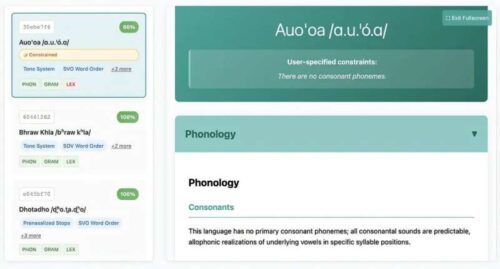
Researchers at the University of Miami have developed ConlangCrafter, an artificial intelligence framework that creates entirely new languages with their own grammar, vocabulary and sound systems. Described in a paper published in the Proceedings of the Association for Computational Linguistics (ACL), the system aims to produce more consistent and diverse constructed languages than conventional large language model prompts.

Unlike general-purpose AI models that generate languages in a single step, ConlangCrafter follows a structured, multi-stage pipeline. It first creates a language’s phonology, grammar and vocabulary before translating text into the constructed language. The framework also reviews and refines its own output, maintaining a “language sketch” that records linguistic rules and helps eliminate inconsistencies.
The research team has already used the framework to generate more than 60 unique languages. Users can define specific design constraints, such as creating a language without consonants or one suitable for an imaginary species communicating through colours and gestures. According to the researchers, the staged approach produces languages that are more internally coherent and linguistically varied than those generated directly by a standard large language model.
Beyond fictional world-building for films, television, books and video games, the researchers believe the technology could support scientific research. Potential applications include studying language evolution, developing tools for under-documented languages with limited written resources, and enabling AI agents to communicate using purpose-built languages designed for specific tasks.
To assess the framework objectively, the team developed evaluation methods that measure how consistently translations follow each language’s rules and how diverse the generated languages are in terms of linguistic features. The researchers say these metrics address one of the biggest challenges in computational creativity. They expect the framework to advance research at the intersection of artificial intelligence, linguistics and digital humanities while providing language creators with a powerful new design tool.

