





What if materials could think and transform? Programmable matter combines computation, sensing and actuation to reshape healthcare, robotics and the future of intelligent systems.
Programmable matter is an innovative concept in the field of advanced materials and computing, referring to substances that can change their physical properties, such as shape, density, optical characteristics, and mechanical behaviour, in a programmable way. These materials combine principles from computer science, robotics, nanotechnology, and materials science to create systems capable of sensing, computation, and actuation. This article provides a detailed exploration of programmable matter, including its classification, working mechanisms, applications, and future potential.
The growth of technology has shifted from static materials to dynamic, intelligent systems. Conventional materials are passive, meaning they do not change unless externally modified. In contrast, programmable matter represents a paradigm shift in which materials can adapt and transform themselves in response to commands or environmental conditions.
The idea of programmable matter has been inspired by science fiction but is gradually becoming a reality due to improvements in microelectronics, artificial intelligence (AI), and nanotechnology. The concept predicts a future where physical objects can be programmed just like software.
Concept of Programmable Matter
Programmable matter refers to materials or systems that can alter their physical state or behaviour in response to commands or environmental conditions, combining computer science, nanotechnology, and robotics.
These changes may include:
- Shape transformation
- Change in density or stiffness
- Alteration of colour or transparency
- Reconfiguration of structure
The primary goal is to embed computational capabilities into matter, enabling it to interact intelligently with its environment.
Types of Programmable Matter
Smart materials
Smart materials are the simplest form of programmable matter. They respond to external stimuli such as heat, light, pressure, or electric fields.
Modular robotics
This type involves multiple small robotic units that can connect, communicate, and rearrange themselves into different structures.
Claytronics
Claytronics is an advanced concept in which nanoscale robots, called ‘catoms’ (claytronic atoms), collaborate to form dynamic three-dimensional shapes.
Digital materials
Digital materials consist of discrete building blocks that can be assembled and reassembled into different structures.
Working principle
Sensors detect environmental changes, processors analyse data, and actuators perform transformations.
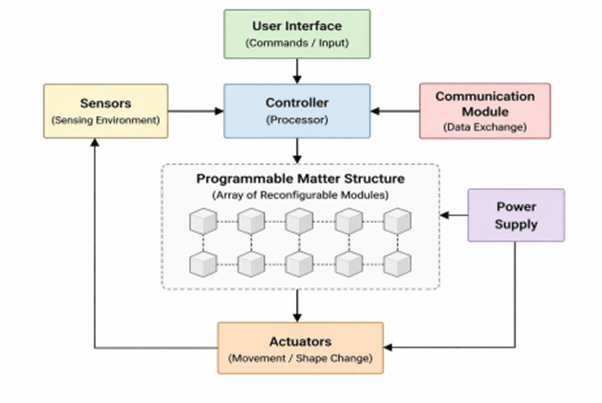
The block diagram of programmable matter represents how different components work together to enable a material to sense, process information, communicate, and change its shape or properties. The process begins with the user interface, where instructions or commands are given to the system. These inputs are received by the controller (processor), which acts as the brain and makes decisions based on the commands and sensor data. The sensors continuously monitor environmental conditions such as temperature, pressure, or position and send this information to the controller.
The communication module ensures smooth data exchange between different units or modules of the system, enabling all parts to coordinate effectively. The controller then sends appropriate signals to the programmable matter structure, which consists of multiple small, reconfigurable modules. These modules use actuators to perform physical actions such as movement, shape transformation, or property changes. All these operations are powered by the power supply, which provides the necessary energy for sensing, processing, communication, and actuation. Thus, the entire system works in a coordinated manner to achieve intelligent and adaptive behaviour in programmable matter.
Applications
Programmable matter has a wide range of applications across various fields due to its ability to dynamically change shape and properties. In healthcare, it can be used for targeted drug delivery systems, smart implants, and artificial tissues that adapt to the human body.
In robotics, programmable matter enables the development of shape-shifting robots for search-and-rescue operations, especially in hazardous or confined environments.
In the construction industry, it can lead to self-assembling buildings and materials that can repair cracks automatically, improving safety and reducing maintenance costs.
In consumer products, it can be used to create adaptive furniture, flexible electronic devices, and smart clothing that adjusts according to user needs. Additionally, in defence and security, programmable matter can be used for advanced camouflage systems and adaptive protective gear.
Overall, its versatility makes it a powerful technology with the potential to transform multiple industries.
Future scope
Programmable matter will enable the development of self-assembling and self-repairing materials in the future. Advances in nanotechnology will enable the creation of microscopic units capable of forming complex structures. It will revolutionise healthcare through smart implants and targeted drug delivery systems.
Smart cities will use programmable matter for adaptive infrastructure and efficient resource management. It will lead to fully reconfigurable environments in which objects can change shape and function on demand.
Programmable matter represents a significant development in science and technology, transforming traditional passive materials into intelligent, adaptive systems. By combining sensing, computation, and actuation, this approach allows materials to change their shape and properties in response to user requirements or environmental conditions.
Although the technology is still in its early stages and faces challenges such as high cost and complexity, its potential applications in healthcare, robotics, construction, and consumer products are vast.
As research progresses, programmable matter is expected to play a crucial role in shaping the future, making everyday objects more flexible, efficient, and responsive to human needs.
Mrs. Vinutha L. B. and Mrs. Anusha T. S. are Assistant Professors at Jain Institute of Technology, Davangere.

