A 5nm AI chip delivers 1,280 TOPS computing power, uses a dataflow design for AI processing, and will power the company’s next smart driving vehicle.
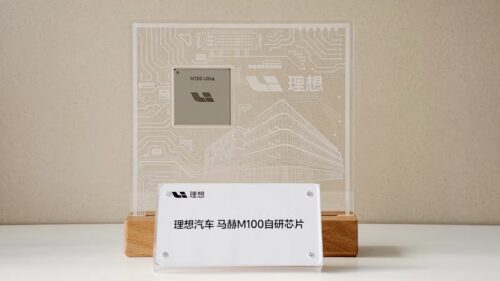
Li Auto has officially unveiled its in-house developed Mach M100 chip after referring to the smart driving processor several times previously.

The Chinese electric vehicle (EV) maker announced key specifications of the M100 chip. The all-new flagship SUV, Li L9 Livis, will be the first vehicle to feature the new chip.
Built on a 5nm automotive-grade process, the Mach M100 is designed to deliver high performance while meeting automotive reliability requirements. The chip offers up to 1,280 TOPS (trillion operations per second) of AI computing performance, which Li Auto claims is the highest for an automotive AI chip.
The M100 uses a dataflow-based AI architecture instead of a traditional cache-based design to improve data movement efficiency for AI workloads. It also features compiler, firmware, and hardware co-design, with the software stack developed alongside the chip to improve AI execution efficiency.
The company also said it developed its VLA 2.1 large model alongside the M100 chip. Li Auto claims this combination reduces end-to-end processing latency by 40% and delivers response speeds twice as fast as human reaction.
Li Xiang, founder, chairman, and CEO of Li Auto, said the company’s in-house chip is not simply following an industry trend but is designed to solve bottlenecks that current supplier technologies cannot overcome.
He added that the rapid increase in AI (artificial intelligence) workloads is driving a fundamental change in chip architecture. According to Li, the dynamic data flow architecture adopted by the M100 breaks through the efficiency bottlenecks of traditional chip designs.
Li also compared the company’s strategy with Apple’s full-stack approach, saying Li Auto is developing its chips, operating systems, large AI models, and hardware simultaneously.
He said this integrated hardware-software design model aims to provide users with an improved embodied AI experience and help bring AI technology into complex physical-world applications.
The upcoming Li L9 Livis will be equipped with two Mach M100 chips, delivering a combined computing power of 2,560 TOPS.