

As India’s electronics boom accelerates, NMTronics is riding the surge with smart SMT lines, EV motor manufacturing solutions, solar manufacturing systems, AI-led automation, and Make-in-India machines. At Productronica 2026, Soni Saran Singh of NMTronics reveals to EFY’s Akanksha Sondhi Gaur and Shreya Singh how the company is helping to build the factories that will power India’s next industrial leap.
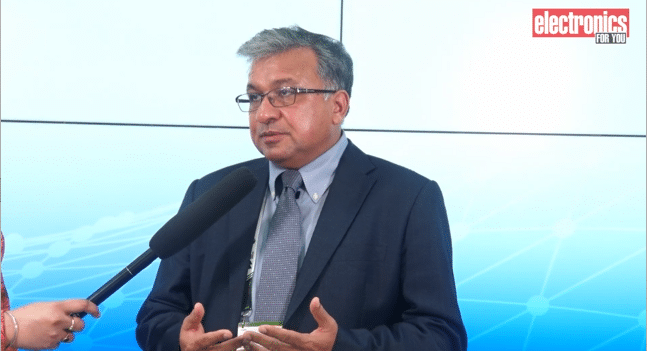
Q. NMTronics has been part of India’s manufacturing journey for decades. Is India’s manufacturing growth structural or just short-term momentum?
A. It is not a cyclical trend but rather a structural one. I have been in this industry for about three decades, and I can tell you that there has never been a more conducive manufacturing ecosystem in India than today. While I used to sell one SMT line annually, we are now selling one SMT line every five or six days. This alone reflects the pace of change. Supportive government policies for electronics manufacturing, localisation, semiconductors, and investments have significantly reshaped the industry.
Q. Which are the new technologies NMTronics is presenting in SMT manufacturing?
A. We are showcasing both advanced global technologies and strong Make in India capabilities. On the global technology side, we have launched the latest Fuji Corporation AIMEX-R platform. Target Zero means zero operator dependency, zero defects, and zero errors. It is about taking manufacturing to higher levels of intelligence, consistency, and productivity. We have also launched advanced screen-printing solutions, including an integrated dual-lane screen printer that saves floor space while significantly improving output efficiency.
Q. You mentioned Make-in-India capabilities. What exactly is NMTronics manufacturing in India?
A. This is one of our most important strategic directions. India must not only manufacture electronic products but also the machines that build them. We are displaying reflow ovens, conveyors, board-handling systems, AOI systems, and laser-marking machines built under our localisation programmes. A major milestone is our joint venture to manufacture Heller Industries reflow ovens in Ahmedabad. These are systems built to global standards and produced in India. That is how nations build industrial strength—by developing not only assembly capabilities but also the capability to manufacture capital equipment.
Q. Everyone talks about smart factories. How does that translate into your world?
A. ‘Smart manufacturing’ is about factories that think, forecast, optimise, and continually improve themselves. Earlier factories relied on machines to perform operations. Tomorrow’s factories rely on data and intelligence. The concept of Target Zero is a step in that direction. This results in fewer manual operations and greater accuracy and consistency. Dark factories are examples of this trend that have emerged worldwide. In dark factories, there is minimal human intervention, and lighting is often unnecessary because machines operate autonomously. Machines communicate with each other, self-correct, optimise their performance, and operate continuously. This might seem futuristic, but it is already happening around the world.
Q. How is manufacturing being transformed by AI, analytics, and traceability?
A. Modern equipment generates massive amounts of data, including placement precision, interruptions, feeder performance, cycle times, defect statistics, thermal images, maintenance warnings, and much more. The problem is not data generation; it is data utilisation. This is where the power of AI comes in. AI sifts through irrelevant data, identifies patterns, anticipates failures, and initiates corrective measures before problems occur. Instead of figuring out what went wrong after the number of rejects rises, the system recognises process drift and reacts before defects increase. Traceability is just as important. Industries such as automotive, telecommunications, defence, industrial electronics, and medical devices require both board- level and component-level traceability.
Q. Industry 4.0 standards are still fragmented. How do you see interoperability evolving?
A. Industry 4.0 is developing through two parallel routes. One is open protocols that allow machines from multiple suppliers to communicate. The second is OEM-led ecosystems, where machine makers create deeply integrated smart factory environments. Both models will coexist. Our role is to ensure that customers gain the benefits of automation without unnecessary complexity.
Q. PCB assembly is getting more complex. How do you solve precision, yield, and quality challenges?
A. There is no single answer because not all high-density PCB manufacturing is the same. A smartphone PCB requires ultra-fine-pitch placement, miniaturisation, and very high-speed throughput. A server motherboard requires different handling, mixed component types, thermal management, and long-term reliability. So, the solution depends on the product. We first study the application before engineering the right line architecture using the appropriate printing capabilities, placement technology, inspection systems, process control, and reflow profiling.
Q. The rupee has weakened against the dollar. How has that affected your business?
A. Currency movements always affect businesses importing capital equipment. However, our exposure is balanced. A major portion of our core SMT technologies comes from Japan, and the rupee–yen equation has remained relatively stable. Some machines still come from South Korea, Taiwan, and China, so there has been some impact. We work closely with customers through commercial optimisation, selective discounts, and localisation strategies to ensure budgets remain manageable.
Q. What level of investment does a modern SMT line require today?
A. That depends entirely on the product type, complexity, automation level, throughput, accessories, and future expansion needs. A line may begin around ₹30–50 million and can exceed ₹200 million for advanced configurations. However, serious customers now look beyond upfront capital expenditure (capex). They ask about ROI, uptime, productivity per square foot, workforce optimisation, and scalability. That is the right way to evaluate a manufacturing investment.
Q. India’s semiconductor push is accelerating. What opportunity does this create?
A. India’s semiconductor journey has started on a strong foundation. We are seeing real policy intent, global participation, and ecosystem creation. I have personally seen developments around projects involving Micron Technology and new initiatives in Sanand. Sanand has the potential to emerge as a major semiconductor manufacturing cluster. Once fabs, OSAT units, materials suppliers, and downstream electronics manufacturers grow together, the multiplier effect can be tremendous. For companies like ours, this also creates demand for precision automation, manufacturing systems, and ecosystem support technologies.
Q. What are your fastest-growing businesses today?
A. We now operate across multiple strategic sectors. First, we remain strong in electronics manufacturing and provide end-to-end factory solutions. Second, we are active in solar manufacturing, supplying capital equipment for solar cell and module production lines. Third, EV motor manufacturing is one of our fastest-growing verticals. At NIDE India, we provide complete solutions for motor manufacturing. We provide manufacturing solutions for various applications such as EVs, Drones, Home Appliances etc.. We offer entire (stand-alone / automatic) line solutions, components and turn-key projects as well. That gives you an idea of the scale we have built. Fourth, through NMT Automation, we manufacture indigenous conveyors, board handling systems, and automation tools that complement our core business.
Q. What is NEST, and why is it important?
A. NEST stands for New Emerging and Strategic Technologies. It is our innovation and incubation platform.
Through NEST, we are developing future technologies, supporting start-ups, and building next-generation AI and industrial automation tools. We believe companies must build tomorrow’s business while continuing to strengthen today’s operations. NEST helps us prepare for future opportunities.
Q. How do you develop the talent pool for advanced manufacturing?
A. While we source talent from reputed institutions such as the Indian Institutes of Technology (IITs), including Delhi and Kanpur, we also recruit from polytechnics and other engineering institutions across India. Our philosophy is straightforward: there is talent everywhere if it is nurtured well. We train young engineers, give them opportunities to work on real industry challenges, and support their professional growth through exposure to advanced technologies. This broad talent base enables us to scale across electronics, EVs, solar technologies, automation, and other emerging technologies simultaneously.
Q. What are your aspirations for the next three to five years?
A. Our aspiration for the next few years is to be among the leading providers of integrated industrial technology solutions. We also plan to expand further in SMT technologies, smart factory solutions, semiconductor ecosystems, solar manufacturing solutions, EV motor manufacturing, and Make-in-India capital equipment. Our innovation efforts will continue through NEST and AI-driven manufacturing systems. As India’s manufacturing ecosystem evolves, technology, execution, and localisation will remain key drivers of growth.
Q. Lastly, what would you like to say to the Indian electronics industry?
A. India is going through a once-in-a-lifetime manufacturing transformation. Sectors including electronics, semiconductors, EVs, solar, and automation are all expanding simultaneously. Companies that invest today in quality, technology, talent, and advanced manufacturing will be better positioned to shape the industry’s future. As for NMTronics, we remain committed to supporting India’s manufacturing growth.