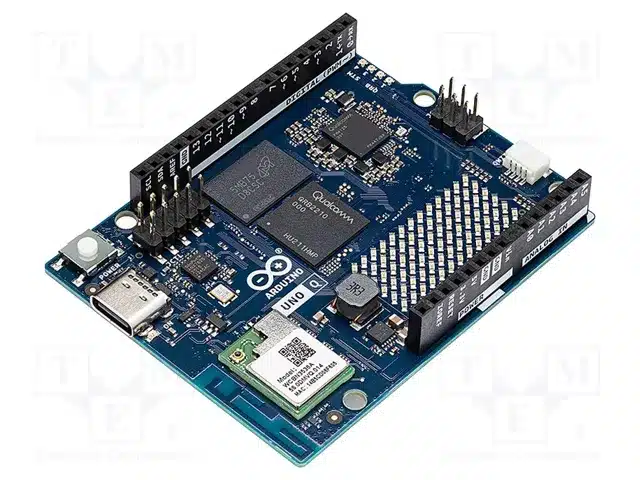
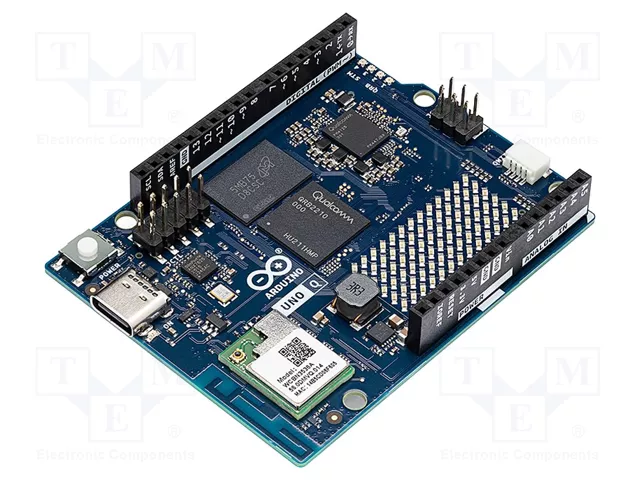
Artificial intelligence is no longer a technology reserved for data centers and high-performance computers. More and more applications operate directly on endpoint devices – closer to sensors, closer to machines, and closer to the user.
Arduino UNO Q was created with projects that utilize local data processing and AI models in mind. It allows you to build solutions for machine condition monitoring, intelligent quality control, or decision-making systems without the need to send all data to the cloud.
We present three practical applications to start working with Edge AI.
Three Applications. One Platform.
Machine Condition Monitoring
Do you really need a PLC to monitor vibrations?

Vibration monitoring is one of the most effective methods for detecting developing faults. Learn how to build a simple Condition Monitoring system using local data analysis and machine learning models.
Quality Control
Does a quality control system always require a smart camera?

Automatic quality control is no longer a solution available only to large manufacturing plants. See how to use AI to detect product defects and build your own Vision Inspection system.
Intelligent Devices
How to run AI models directly on the device?
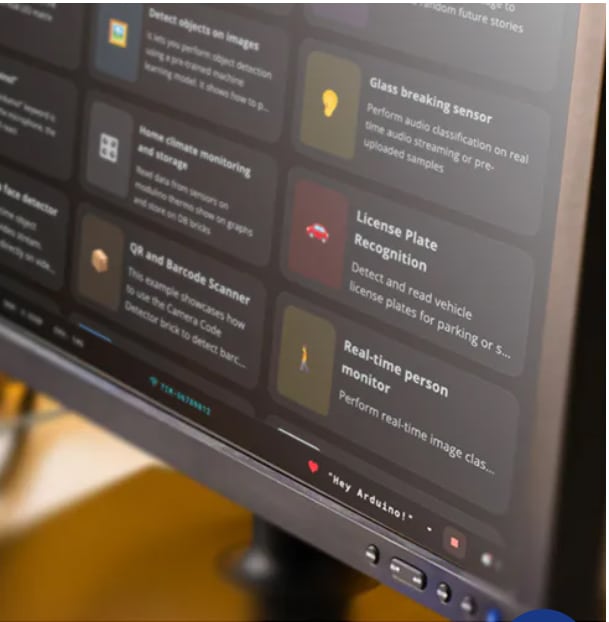
Not every AI application needs the cloud. Discover the possibilities of local data processing and learn how to create intelligent devices that make real-time decisions.
WHY ARDUINO UNO Q?
Not every AI project requires a high-performance industrial computer or an extensive automation system. More and more applications can be realized using compact embedded platforms that analyze data locally and work with a wide ecosystem of sensors and communication modules.
Arduino UNO Q was designed specifically for such applications. The platform allows you to build solutions in the field of Edge AI – from demonstrators and Proof of Concept projects to more advanced industrial applications.
Build a Complete Solution with TME
Arduino UNO Q is just the beginning. TME’s offer also includes all the components needed to implement the project:
- sensors and accelerometers,
- communication modules,
- displays,
- power supplies,
- cables and connectors,
- enclosures and mounting accessories.
This allows you to assemble a complete set necessary to build your own AI solution – from the first prototype to the finished system.
Check out the ARDUINO UNO Q Offer and Components for EDGE AI Projects