




A new gallium nitride transistor withstands nearly 4,000 volts, promising more efficient power conversion for electric vehicles, data centres, and demanding industrial systems worldwide.
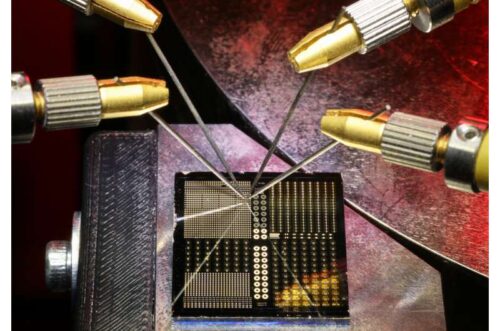
EPFL’s Power and Wide-band-gap Electronics Research Lab (POWERlab) has developed a new gallium nitride (GaN) transistor capable of withstanding nearly 4,000 volts, marking a significant step towards higher-voltage power electronics.
The chip-sized device, built from GaN layers on a low-cost silicon base, can handle more than five times the voltage of many commercial GaN power devices, which typically operate at around 600–650 volts. The advance could help reduce energy losses in systems where electricity must be converted at high voltage.
Researchers achieved the result by exploiting GaN’s natural polarisation effects through an intrinsic polarisation superjunction (IPSJ) architecture. The approach distributes the electric field more evenly inside the device, helping prevent breakdown at extreme voltages.
The transistor also avoids conventional chemical doping, commonly used to control charge in semiconductor devices. According to the researchers, eliminating doping can improve robustness because doped structures may become more temperature-sensitive during operation.
The combination of high-voltage capability and low electrical resistance is particularly important for electric vehicles, industrial power systems and data centres. Higher-voltage operation can enable more efficient power conversion, while lower resistance reduces energy dissipated as heat.
POWERlab says the balanced design allows the transistor to withstand more than five times the voltage of conventional GaN devices. Researchers are now working towards combining the high-voltage architecture with additional conduction channels to reduce resistance further.
If developed into practical power components, the technology could support smaller, cooler and more efficient power-conversion systems. Its ability to operate under high electrical and thermal stress could also strengthen GaN’s position in applications traditionally dominated by silicon-based power electronics.

