






A high-entropy layered-oxide cathode retains 90 per cent of its capacity after 2,300 cycles in ampere-hour-class pouch cells, addressing a key durability challenge for sodium-ion batteries.
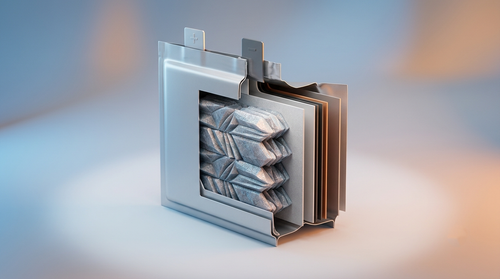
Researchers at the Eastern Institute for Advanced Study in Ningbo, together with collaborators at the Hong Kong Polytechnic University, South China University of Technology and the Chinese Academy of Sciences, have developed a high-entropy layered-oxide cathode designed to reduce structural degradation in sodium-ion batteries.
The researchers focused on a recurring structural change in layered-oxide cathodes. During sodium-ion insertion and removal, the cathode can transition between O3 and P3 crystal structures. Repeated transitions can introduce lattice strain and contribute to structural degradation of the active material, eventually reducing battery capacity.
The team used configurational entropy to modify this behaviour by incorporating multiple metal species into the cathode lattice. According to the researchers, the resulting high-entropy structure regulates ion diffusion and changes how the material undergoes phase transitions. The researchers report that this approach makes the transition more strongly governed by thermodynamic stability rather than abrupt kinetic changes.
The reported electrochemical results show the effect of the approach. The full cell delivered approximately 162.5 Wh/kg at a 0.1C rate and retained 97.7 per cent of its capacity during a 5C charge and 1C discharge test. More significantly, ampere-hour-class pouch cells retained 90 per cent of their initial capacity after 2,300 cycles.
The pouch-cell result is relevant because it moves the demonstration beyond the small coin-cell format commonly used during early-stage battery research. However, it remains a laboratory demonstration rather than evidence of a production-ready sodium-ion battery. Commercial suitability will also depend on factors such as manufacturing cost, pack-level energy density, safety, material availability and long-term operation under practical conditions.
Sodium-ion batteries are being investigated as an alternative to lithium-ion chemistry for applications where cost, resource availability and cycle life can be prioritised over maximum energy density. Sodium is more abundant than lithium, while some sodium-ion chemistries can reduce or avoid the use of metals such as cobalt and nickel. The trade-off is generally lower energy density than established lithium-ion chemistries.
The reported cathode addresses one of the technical challenges associated with layered-oxide sodium-ion batteries: maintaining structural stability during repeated cycling. By controlling the material’s configurational entropy, the researchers aim to regulate the phase transition that can otherwise contribute to degradation.
The researchers also suggest that the entropy-engineering strategy could be extended to other layered-oxide chemistries. This broader applicability remains a research claim and will require validation across different materials, electrode compositions and cell configurations.
For stationary energy storage, where energy density requirements can be less demanding than in some mobility applications, improvements in cycle life could make sodium-ion chemistry more attractive. However, translating the reported cathode performance into commercial cells will require further work on material synthesis, electrode processing, cell design and manufacturing scalability.
The study therefore demonstrates a materials-engineering approach to improving sodium-ion battery durability. Retaining 90 per cent capacity after 2,300 cycles in ampere-hour-class pouch cells indicates that controlling phase transitions through configurational entropy can help address structural degradation, while further testing will be needed to determine how the approach performs at commercial scale and under real-world operating conditions.
For more information, click here.

