






New autferroic materials could accelerate physical random number generation, potentially improving encryption hardware speed, signal clarity, and security without compromising reliable data processing operation performance.
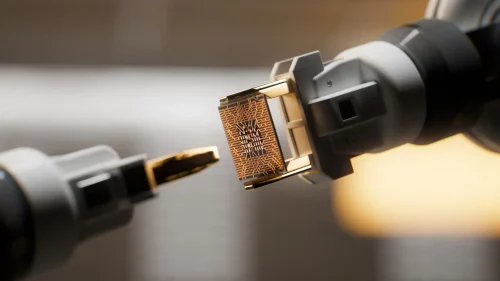
Rice University and Southeast University researchers have proposed an autferroic true random number generator (TRNG) device principle that could accelerate hardware encryption while maintaining clear electrical signals. The theoretical approach uses a new class of materials to address speed limitations in physical random-number generation for security chips.
Conventional TRNGs rely on unpredictable physical fluctuations to generate random bits used by encryption systems. However, increasing switching speed can weaken signal quality, creating a trade-off between faster operation and reliable readout. The researchers say autferroic materials can address this limitation through a distinctive interaction between electrical and magnetic states.
Instead of forcing a direct transition between magnetic states, the proposed autferroic mechanism routes switching through an intermediate electrical state. This lowers the energy barrier by nearly two-thirds while preserving the strength of the magnetic signal. As a result, the simulated device can switch much faster without introducing the signal degradation associated with conventional approaches.
Computer simulations and dynamic modelling showed that the switching rate could increase from fewer than 100 flips per second to more than 400,000 flips per second. The researchers calculated that the architecture could ultimately generate more than one million random bits per second. The generated randomness also passed standard National Institute of Standards and Technology statistical benchmark tests.
The approach could support hardware security applications where fast and reliable random-number generation is important, including encryption, secure processors, data processing and other information technologies. The work remains a theoretical research result, rather than a commercial security chip or finished product.
The study, published in Physical Review Letters, demonstrates how autferroic materials could provide a route towards faster physical random-number generation. Further device development and experimental validation will be needed to determine whether the simulated performance can be achieved in practical microchip implementations.

