





Behind every semiconductor lies a carefully orchestrated journey of architecture, design, verification and validation that turns engineering concepts into high-performance electronic systems.

Semiconductors have become the foundation of modern technology, powering everything from smartphones, data centres and communication networks to electric vehicles, industrial automation, artificial intelligence (AI) and healthcare systems. As demand for advanced electronics continues to grow, countries worldwide are investing heavily in semiconductor design, manufacturing and research to strengthen their technological capabilities.
India is entering an important phase in this global transformation. Government initiatives, expanding electronics manufacturing, increased investment in semiconductor facilities and stronger industry-academia collaboration are creating new opportunities for innovation. At the same time, engineering education is evolving to provide students with greater exposure to digital design, embedded systems, very-large-scale integration (VLSI), field-programmable gate arrays (FPGAs) and processor architecture.
Unlike previous decades, when semiconductor development was largely confined to major corporations and specialised research laboratories, today’s students have access to sophisticated simulation tools, affordable development platforms and open-source resources. These technologies allow them to explore processor design, hardware description languages, embedded computing and system validation without requiring access to fabrication facilities.
This shift has broadened participation in semiconductor development. Modern chip design depends on a wide range of engineering disciplines, including architecture development, register-transfer level (RTL) design, verification, physical implementation, packaging, testing and software integration. As a result, meaningful contributions can be made long before a design reaches the fabrication stage.
For aspiring semiconductor engineers, the journey therefore begins not inside a fabrication plant, but with understanding how complete hardware systems are conceived, designed, validated and optimised. Building this system-level perspective is becoming increasingly important as semiconductor products grow in complexity and integrate computing, communication, sensing and intelligent processing into a single device.
Semiconductor innovation extends beyond fabrication
Semiconductor manufacturing often attracts the greatest public attention because of the enormous investment required to build fabrication facilities. However, fabrication represents only one stage in a much broader engineering process.
Every semiconductor product begins with identifying an application and defining its performance, power and reliability requirements. These objectives are translated into an architecture that determines how the system will process instructions, manage memory, communicate with peripherals and achieve its performance targets.
Once the architecture has been established, engineers develop the hardware using RTL descriptions, which model the digital behaviour of the design before it is implemented in silicon. Extensive simulation and verification are then carried out to confirm that the design behaves as intended under different operating conditions.
After functional validation, the design progresses through synthesis and physical implementation, where logical descriptions are converted into manufacturable layouts while meeting constraints such as timing, power consumption, routing complexity and silicon area. Only after these stages are complete does fabrication begin, followed by packaging, testing, firmware integration and software development.
Each stage requires specialised expertise. Some engineers focus on processor architecture, while others specialise in digital logic design, verification, FPGA-based prototyping, physical design, testing or embedded software. Together, these disciplines form an interconnected semiconductor ecosystem in which each activity influences the final product.
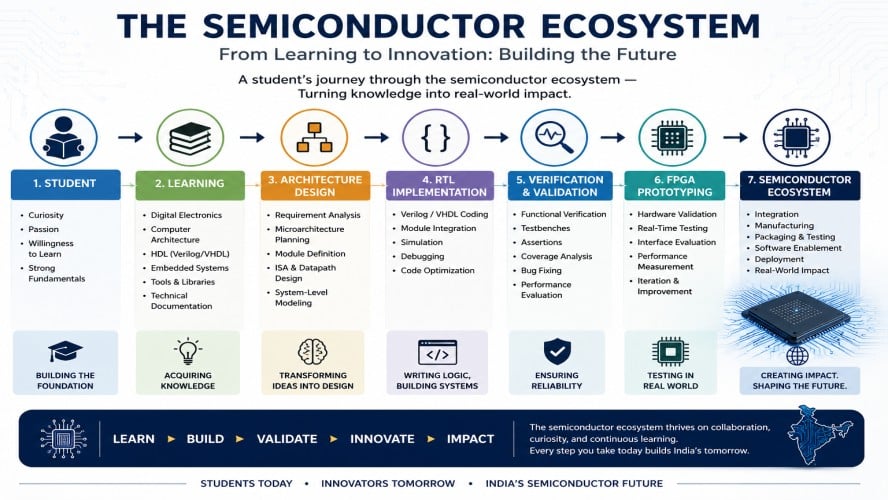
Recognising the breadth of this ecosystem is important for students entering the field. Semiconductor engineering offers opportunities across the entire development cycle, allowing engineers with different skills and interests to contribute to the creation of advanced electronic systems.
The semiconductor design journey
Although semiconductor manufacturing receives the greatest attention, the development of a semiconductor device begins much earlier. Every successful chip follows a structured engineering process that transforms an idea into a manufacturable product through multiple stages of design, verification and optimisation.
The process starts with defining the system requirements. Engineers identify the intended application, performance targets, power budget, reliability expectations, communication interfaces and scalability requirements. These considerations establish the design objectives and influence every subsequent stage of development.
The next stage is architecture development, where the system’s overall organisation is defined. Engineers determine how instructions will be executed, how data will move through the system, how memory will be organised and how different functional blocks will interact. Decisions made at this stage have a lasting impact on performance, power consumption, silicon area and software compatibility.
Once the architecture has been finalised, implementation begins with register-transfer-level (RTL) design. Using hardware description languages such as Verilog, engineers describe the behaviour of digital circuits before they are synthesised into hardware. Simulation tools are then used to verify that the design performs as intended under different operating conditions.
Validation is an iterative process rather than a single milestone. Functional simulations, timing analysis and repeated design revisions are carried out until engineers are confident that the design satisfies its specifications. This iterative approach enables potential issues to be identified and resolved long before fabrication, significantly reducing development time and cost.
After verification, the design progresses through logic synthesis and physical implementation. During these stages, the RTL description is converted into a gate-level design and then into a physical layout that satisfies constraints such as timing, routing, power consumption and silicon area. Only after these requirements have been met does the design move to fabrication, followed by packaging, testing and software integration.
Understanding this workflow helps students appreciate that semiconductor engineering extends well beyond writing code or designing circuits. Every stage depends on decisions made earlier in the design process, making collaboration between architecture, design, verification and implementation teams essential to the success of a project.
Why processor architecture matters
Among the many disciplines within semiconductor engineering, processor architecture occupies a particularly important position because it establishes the foundation on which the rest of the design is built.
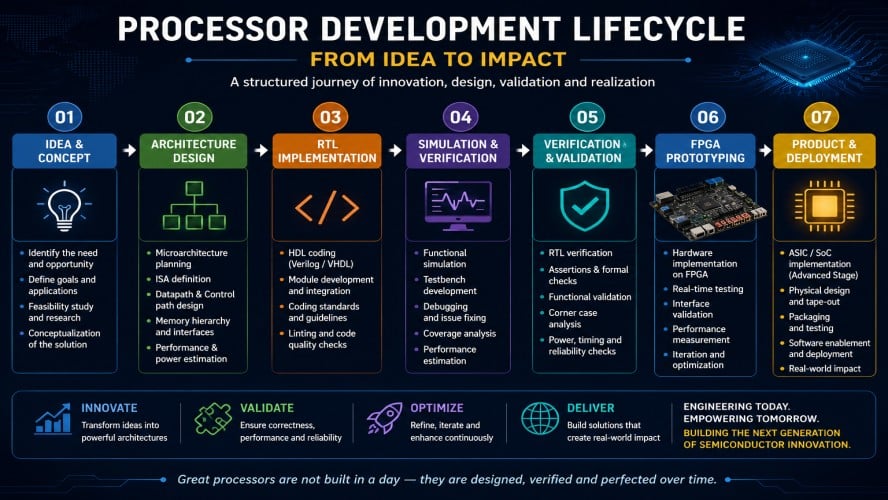
Architecture defines how a processor executes instructions, accesses memory, communicates with peripherals and balances competing requirements such as performance, power consumption, silicon area, scalability and reliability. Even seemingly small architectural changes can influence pipeline behaviour, memory bandwidth, execution efficiency and software compatibility, affecting the entire design.
For this reason, architecture development is as much about making engineering trade-offs as it is about innovation. Designers rarely optimise a processor for a single parameter. Instead, they seek the best balance between performance, complexity, power efficiency and implementation cost for the intended application.
Studying processor architecture also encourages systems-level thinking. Rather than viewing individual modules in isolation, engineers learn to understand how decisions in one part of the design influence the behaviour of the complete system. This perspective becomes increasingly valuable as modern semiconductor devices integrate multiple processing cores, dedicated accelerators, memory subsystems and communication interfaces onto a single chip.
For students, exploring processor architecture provides an excellent introduction to semiconductor design because it combines digital logic, embedded computing, memory systems and hardware optimisation. More importantly, it demonstrates that successful hardware development begins with careful planning rather than implementation alone.
From simulation to hardware: The role of FPGA and validation
A semiconductor design does not move directly from simulation to fabrication. Before committing a design to silicon, engineers must verify that it behaves as intended under realistic operating conditions. This makes verification and validation among the most critical stages of semiconductor development.
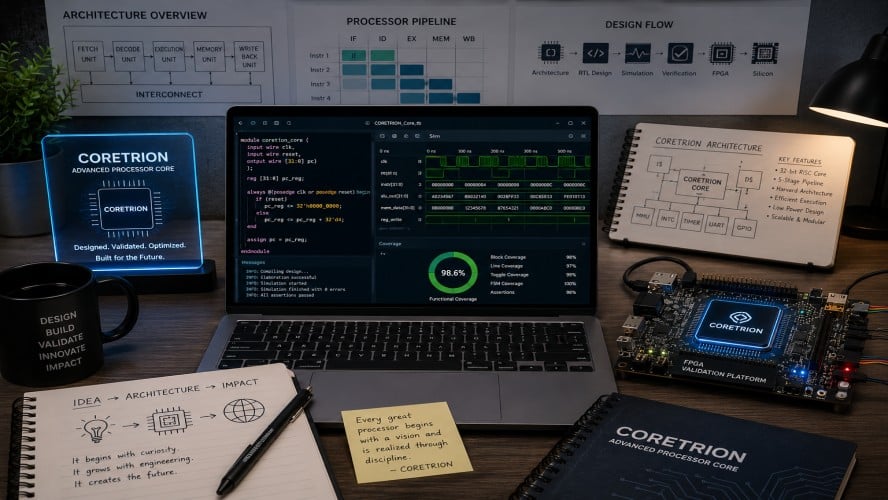
Simulation provides the first level of confidence by allowing designers to evaluate the logical behaviour of a circuit without building physical hardware. Functional simulations confirm whether the design meets specification, while timing analysis identifies issues related to signal propagation and clock synchronisation. Detecting these problems early avoids costly redesigns later in the development cycle.
Although simulation is indispensable, it cannot reproduce every real-world operating condition. Many designs, therefore, undergo hardware validation using field-programmable gate arrays (FPGAs), which provide a practical platform for testing digital systems before fabrication.
Unlike application-specific integrated circuits (ASICs), FPGAs are reconfigurable devices that allow engineers to repeatedly implement, modify, and evaluate hardware designs. This flexibility makes them valuable for processor development, digital system validation, interface testing and architectural exploration.
By implementing a design on an FPGA, engineers can observe how it behaves under actual operating conditions. Signal timing, communication interfaces, resource utilisation and system performance can all be evaluated before committing to an expensive manufacturing process. Design assumptions can be verified, unexpected limitations identified, and alternative approaches assessed with relatively little cost or risk.
For students, FPGA platforms provide an effective bridge between theory and practice. Concepts learned in digital electronics or computer architecture can be translated into working hardware, allowing students to gain experience with implementation, debugging and system integration. This practical exposure develops a deeper understanding of hardware behaviour than simulation alone.
Validation extends beyond confirming that a circuit functions correctly. It also evaluates whether the design satisfies performance, reliability and efficiency requirements under different operating conditions. Modern semiconductor development therefore, combines behavioural simulation, functional verification, hardware validation and performance analysis to build confidence before fabrication.
This process is inherently iterative. Results obtained during validation frequently lead to architectural refinements, design modifications or optimisation of individual subsystems. Multiple design iterations are often required before performance targets, power budgets and reliability requirements are achieved.
Rather than indicating shortcomings, these iterative improvements are a normal part of engineering practice. Successful semiconductor products evolve through repeated refinement, with each design cycle improving functionality, efficiency and robustness before the device enters production.
Engineering documentation: An often-overlooked design tool
Engineering is not only about designing and validating hardware but also about documenting the decisions made throughout the development process. Well-structured technical documentation enables complex projects to be understood, reproduced and improved by other engineers.
Design documents typically record system requirements, architectural decisions, interface specifications, verification procedures, performance measurements and revision histories. Maintaining these records provides traceability throughout the development cycle and simplifies debugging, design reviews and future upgrades.
Documentation also facilitates collaboration. Modern semiconductor projects involve multidisciplinary teams working on architecture, digital design, verification, physical implementation, embedded software and testing. Clear documentation ensures that design intent is communicated accurately across these disciplines, reducing the risk of errors and improving development efficiency.
For students and early-career engineers, developing good documentation habits is as important as learning design tools. Technical reports, architecture descriptions, implementation notes and verification results not only strengthen engineering discipline but also demonstrate a systematic approach to problem-solving. In both academia and industry, these records often become as valuable as the hardware itself because they preserve the knowledge needed for future development.
Research and technical publications extend this process by sharing new ideas, design methodologies and implementation experiences with the wider engineering community. Beyond disseminating knowledge, they encourage collaboration, critical evaluation and continuous improvement, contributing to the advancement of semiconductor technology.
Building a stronger semiconductor ecosystem
The rapid growth of the semiconductor industry has increased the demand for engineers with expertise across the complete product development cycle. While fabrication facilities remain a strategic priority, sustained growth also depends on strengthening capabilities in processor architecture, digital design, verification, embedded systems, electronic design automation (EDA) tools, advanced packaging and system integration.
India has made significant progress in developing this broader ecosystem. Government initiatives, increased private investment and collaborations between industry, academia and research institutions are creating opportunities for innovation across semiconductor design and electronics manufacturing. At the same time, universities are expanding programmes in very-large-scale integration (VLSI), embedded systems, computer architecture and integrated circuit design to prepare students for emerging industry requirements.
This expanding ecosystem offers opportunities beyond traditional chip manufacturing. Engineers contribute to processor development, hardware verification, embedded software, artificial intelligence (AI) accelerators, Internet of Things (IoT) platforms, automotive electronics, communication systems and high-performance computing. These diverse applications require multidisciplinary expertise and close collaboration between hardware and software teams throughout the product lifecycle.
Open-source hardware initiatives, affordable FPGA development boards and increasingly accessible design software have also lowered the barriers to semiconductor education. Students can now explore processor design, digital logic and embedded systems using professional development tools, enabling them to gain practical experience well before entering industry.
Preparing for a career in semiconductor engineering
Technical knowledge alone is no longer sufficient for success in semiconductor engineering. Modern development projects require engineers to combine analytical thinking with practical implementation skills, effective communication and the ability to work within multidisciplinary teams.
A solid understanding of digital electronics, processor architecture, embedded systems and hardware description languages provides the technical foundation. Equally important is familiarity with simulation, verification, debugging and system integration, which enable engineers to translate theoretical concepts into reliable hardware.
Hands-on projects play a crucial role in developing these skills. Designing processors, implementing embedded systems, developing IoT applications or building FPGA-based prototypes exposes students to real engineering challenges, including design trade-offs, debugging and performance optimisation. Such experience strengthens problem-solving skills and provides a better understanding of the complete development process than classroom study alone.
Technical documentation is another valuable skill. Preparing design reports, recording validation results and documenting engineering decisions improve project traceability and facilitate collaboration. Clear documentation also enables future design improvements by preserving the rationale behind key technical decisions.
Participation in technical publications, student competitions, open-source projects and collaborative research further broadens engineering experience. These activities encourage critical thinking, expose students to new technologies and help them understand how engineering solutions evolve through collaboration and iterative refinement.
Looking ahead
Semiconductor technology continues to evolve rapidly, driven by advances in artificial intelligence, high-performance computing, automotive electronics, wireless communication and edge computing. Emerging technologies such as chiplet architectures, heterogeneous integration, advanced packaging and domain-specific processors are reshaping the way electronic systems are designed and manufactured.
As devices become more complex, engineers will need a broader understanding of complete systems rather than isolated technologies. Future semiconductor development will increasingly rely on collaboration between specialists in architecture, digital design, verification, embedded software, packaging and manufacturing to deliver efficient, reliable and scalable solutions.
For aspiring engineers, this presents an opportunity to contribute at every stage of the development process. Whether working on processor architecture, digital design, embedded systems, verification or system integration, a strong understanding of engineering fundamentals, combined with practical implementation experience, remains the foundation of successful semiconductor innovation.
Authored By: Y. V. D. Kausthubh. The author is an electronics and communication engineering student from Hyderabad with interests in semiconductor systems, processor architecture, very-large-scale integration (VLSI), embedded systems, the Internet of Things (IoT) and hardware-software co-design. His work focuses on translating engineering concepts into practical implementations through experimentation, validation and multidisciplinary system development.


