Build wearables faster with sensors, Bluetooth, and extended battery life—powered by
ready-to-use reference designs.
Wearable electronics are increasingly common in health, fitness, and industrial applications, but designing them remains complex. Reference designs from leading OEMs simplify the process, providing ready platforms that enable engineers to connect sensors, manage power, and integrate wireless features without creating every circuit from scratch. Below are some notable examples worth exploring.
Wearable Demo
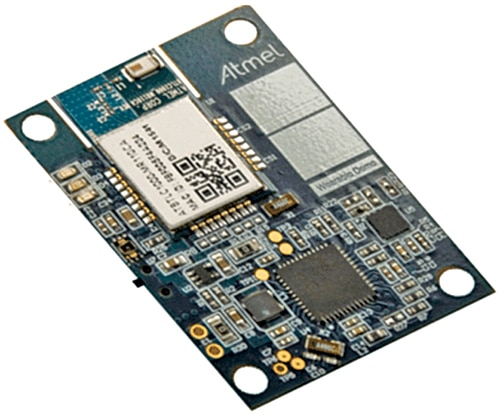
The Wearable demo reference design provides engineers with a foundation for developing wearable electronics with sensors and wireless connectivity. It includes a 6-axis IMU with a sensor fusion core, an environmental sensor for pressure, humidity, and temperature, and a light and UV sensor enabling applications such as fitness trackers, health monitors, or environmental sensors. A cryptographic module supports authentication and data protection. With built-in sensor fusion, additional software is not required to detect steps, calculate rotation vectors, or recognise activities.
The design offers low-power wireless connectivity, built-in motion processing to reduce controller load, environmental and light sensors, secure on-device operation, and a compact form with multiple sensors and indicators, making wearable development easier.
Applications: Suitable for motion sensing, environmental monitoring, and BLE connectivity
Check more tech details here: Wearable demo reference design
OEM Brand: Atmel
Wearable heart rate monitor
Designing wearable medical devices requires combining heart rate monitoring with health and compliance tracking. Most devices rely on reflective monitors that struggle with noise, even when using advanced circuits. This demonstration board for wearable heart rate monitoring measures heart rate using a phase division multiplexing technique, enabling multiple signals to be captured simultaneously without interference.
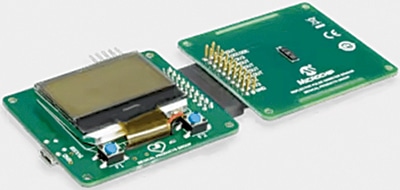
The MCU’s built-in core-independent peripherals (CIPs), 10-bit digital-to-analogue converters (DACs), operational amplifiers, and configurable logic cell (CLC) reduce the need for external components, simplifying design and lowering the bill of materials (BOM) cost. Engineers can control LED intensity and manage LED driving without using the CPU, reducing software complexity and improving efficiency.
Applications: Suitable for applications including lighting, power supplies, battery charging, motor control, and other general purposes
Check more tech details here: Wearable heart rate monitor
OEM Brand: Microchip
Heart-rate monitor wrist band