




A 24V to 5V isolated flyback design shows power conversion, testing, and control in one setup, helping you check performance and build prototypes faster.
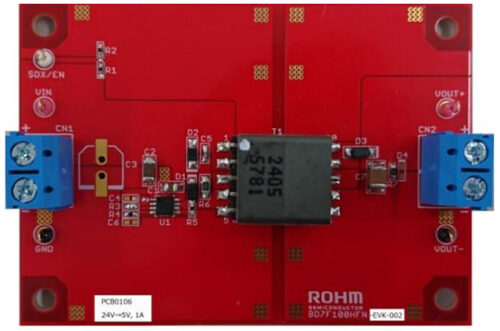
Developing an isolated flyback power supply often involves multiple design iterations to achieve stable regulation, acceptable efficiency, and reliable operation. ROHM‘s REFFLBK001 reference design gives design engineers a proven starting point that can reduce development time and help validate design choices before creating a custom power supply.
The reference design converts a 24V DC input into an isolated 5V output capable of delivering up to 1A. Operating at a switching frequency of 400kHz, it delivers up to 5W of output power with a peak efficiency of 77.5%. Implemented on a compact 70mm × 50mm PCB, the design demonstrates how an isolated power supply can be realized without requiring engineers to develop every stage from scratch.
Instead of focusing only on the controller, the design presents the complete power conversion chain. Engineers can study how the primary switching stage transfers energy through the flyback transformer, how the secondary side rectifies the output, and how the feedback network maintains a regulated 5V output under changing load conditions. The design also incorporates output voltage clamping and filtering, providing a complete example of an isolated DC-DC converter suitable for practical applications.
The hardware allows engineers to evaluate converter performance under actual operating conditions. With a 24V DC input supply connected, loads ranging from no load to the rated 1A output current can be applied while monitoring the converter through dedicated measurement points. This makes it possible to observe output regulation, startup behaviour, and overall converter operation before integrating the design into a larger system. Such evaluation can help identify potential issues early in the development cycle and reduce the need for repeated hardware revisions.
An interesting aspect of the reference design is that it is available in two hardware versions that use the same flyback architecture and output stage while differing only in the controller package. This enables engineers to compare package options without redesigning the surrounding circuitry, making it easier to select a device based on board space, assembly process, or thermal requirements.
The PCB implementation also provides useful design insight. Engineers can examine how the transformer, switching components, passive devices, and isolation boundary are arranged to minimize switching current loops while maintaining isolation between the primary and secondary sides. These layout practices can serve as a reference when designing custom isolated converters for production hardware.
The reference design is suitable for applications that require a regulated isolated 5V rail from a 24V source, including industrial controllers, PLCs, communication equipment, sensors, factory automation systems, and embedded electronics. Because it demonstrates a complete working implementation rather than an individual circuit block, it can also shorten the path from evaluation to prototype development.
ROHM has tested this reference design. It comes with a bill of materials (BOM), schematics, assembly drawing, printed circuit board (PCB) layout, and more. The company’s website has additional data about the reference design. To read more about this reference design, click here.

