




A new reference design combines field-oriented control, integrated motor-drive functions and compact packaging to improve drone propulsion performance, response and efficiency for aerial platforms.
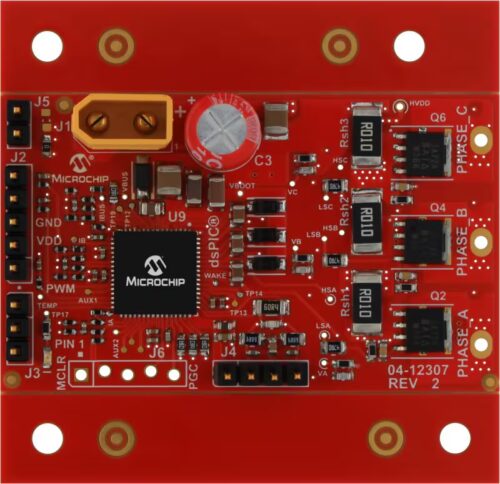
Microchip has introduced its Drone 3S Electronic Speed Controller (ESC) Reference Design, a compact motor-control solution intended to improve propulsion performance in drone applications. The design uses sinusoidal field-oriented control (FOC) rather than conventional trapezoidal control, with an emphasis on dynamic response, torque stability and reduced electromagnetic interference.
The reference design is built around a motor-control digital signal controller and a three-phase brushless DC motor gate-driver stage. Its design benefits include improved dynamic response during acceleration, stable torque with low EMI and noise, improved stall handling and protection, and a highly integrated system-in-package approach aimed at maintaining a small form factor.
At the heart of the design is the dsPIC33CDVC256MP506, described in the reference-design bill of materials as a motor-control DSC with a full-bridge MOSFET gate driver and CAN transceiver. The device provides 100 MHz operation, 256 KB of flash memory and 24 KB of RAM, alongside 64 pins and an integrated motor driver.
The solution diagram also shows the MCP8021 three-phase brushless DC motor gate driver working with six N-channel MOSFETs to drive the motor. The architecture is designed to manage the power stage while supporting the controller’s motor-control functions.
The controller includes features intended for demanding propulsion systems, including PWM support, analogue-to-digital conversion capabilities, programmable fault inputs and configurable quadrature encoder functionality. These features provide flexibility for different motor-control implementations.
By combining the controller, gate-driver and power-stage elements within a compact reference design, the approach aims to simplify development for drone propulsion systems. Microchip also provides design documentation and a reference-design bill of materials, giving developers a starting point for evaluating and adapting the architecture to their own applications.

