


Many electronic circuits require a voltage higher than the available power supply. For instance, when only a 12V battery or adaptor is available but a circuit requires 20V to 24V, a voltage boosting arrangement becomes necessary. One simple and economical way to achieve this is by using a charge-pump voltage doubler driven by an oscillator.
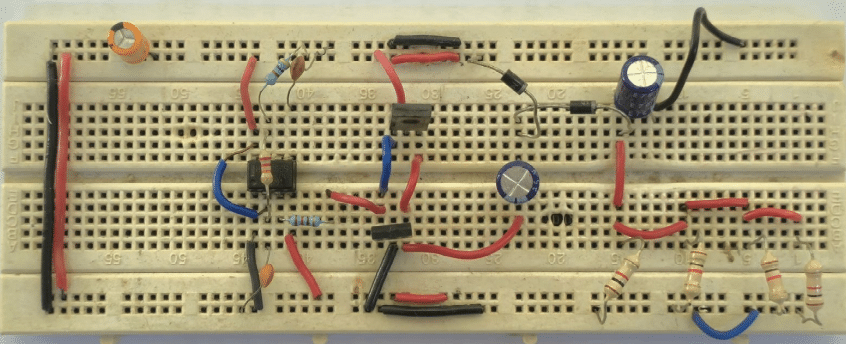
The circuit is suitable for small power supplies, op-amp circuits, analogue electronics experiments, and various DIY projects where a moderately higher DC voltage is required from a lower-voltage source. Fig. 1 shows the author’s prototype.
Circuit and Working
Fig. 2 shows the circuit diagram of the voltage doubler circuit. It is built around the NE555 timer (IC1), transistors BD139 (T1) and BD140 (T2), and a few passive components. The circuit consists of four main sections: the oscillator stage, the driver stage, the voltage-doubler network, and the output filter stage.
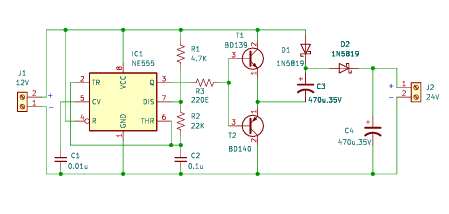
IC1 (NE555) is configured as an astable multivibrator to generate a square-wave signal. Resistors R1 (4.7kΩ) and R2 (22kΩ), together with capacitor C2 (0.1µF), set the oscillation frequency to approximately 3kHz. Capacitor C1 (0.01µF) is connected to the control voltage pin to improve stability and reduce noise. The square-wave signal available at pin 3 drives the complementary transistor pair T1 (BD139) and T2 (BD140), which operate in push-pull mode. This driver stage increases the current-handling capability and improves the charging and discharging action required for efficient voltage doubling.
The voltage-doubler section is formed by Schottky diodes D1 and D2 (1N5819) along with capacitors C3 and C4. During one half cycle of the oscillator output, capacitor C3 charges through diode D1. During the opposite half cycle, the stored charge in C3 is added to the supply voltage and transferred through diode D2 to capacitor C4. This action produces an output voltage approximately twice the input voltage.

Schottky diodes are selected because of their low forward voltage drop and fast switching characteristics, which improve circuit efficiency. Capacitor C4 acts as the output filter capacitor, smoothing the pulsating waveform to provide a relatively stable DC output at connector J2. When powered from a 12V DC supply connected at J1, the circuit typically delivers about 20V to 24V DC, depending on the load and component tolerances.
Construction and testing
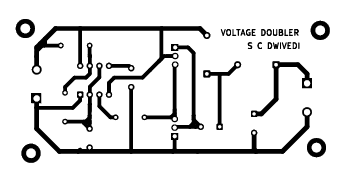
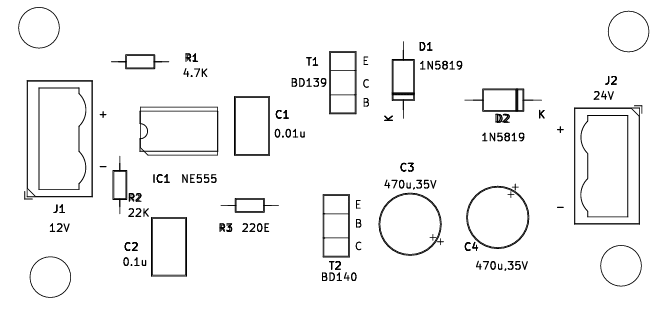
An actual-size, single-sided PCB layout for the voltage doubler is shown in Fig. 3, while the corresponding component layout is shown in Fig. 4. After assembling the circuit on the PCB, mount it inside a suitable enclosure for reliable operation and protection.
Download PCB and Component Layout PDFs: click here
Alternatively, the circuit may also be assembled on a general-purpose PCB or a small perforated board. Begin the assembly by mounting the IC socket for the NE555 timer, followed by resistors R1 and R2, and capacitors C1 and C2 associated with the oscillator section. Ensure proper soldering and correct component placement for stable oscillator operation.
Next, mount transistors BD139 (T1) and BD140 (T2), ensuring the correct orientation of their collector, base, and emitter terminals. For applications requiring higher output current, small heat sinks may be fixed to the transistors to improve heat dissipation and prevent overheating.
After completing the driver stage, solder Schottky diodes D1 and D2, carefully observing their polarity. Then solder electrolytic capacitors C3 and C4 with proper polarity orientation. Finally, connect input connector J1 for the 12V DC supply and output connector J2 for the boosted DC output.
Once assembly is complete, thoroughly inspect the PCB for solder bridges, dry joints, incorrect wiring, or reversed component polarity before applying power.
For testing, connect a regulated 12V DC supply to connector J1. Using a digital multimeter, measure the voltage across output connector J2. Under no-load or light-load conditions, the circuit should produce an output voltage of approximately 20V to 24V DC.