





Helipole is a fibre-reinforced composite pole designed for applications such as street lighting, telecom towers, smart poles, and electrical distribution.
Helipole, a brand developed by CNC Technics Pvt Ltd, was launched in 2018 by Vijay Krishna Bandaru along with his sons Rahul and Rohit. The company found that traditional steel-and-concrete poles were prone to failure, particularly in coastal and high-wind regions. Drawing on their expertise in composite materials, CNC Technics (incorporated in 1986) introduced Helipole—lightweight, corrosion-resistant composite utility poles designed for long-term durability.
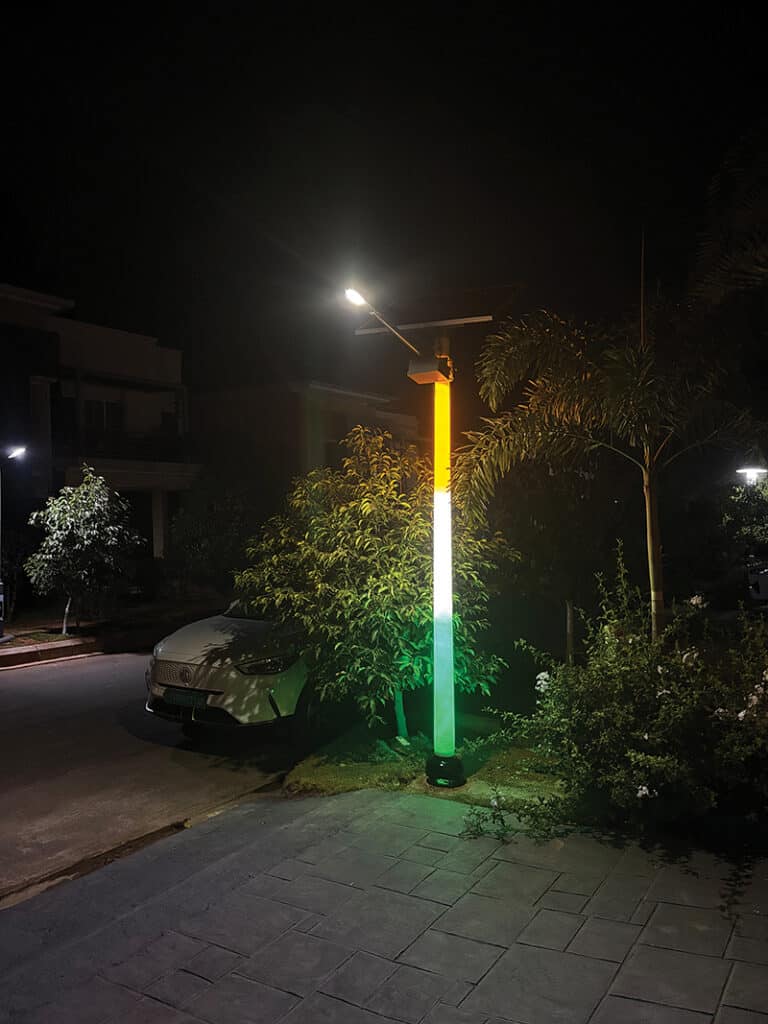
Helipole is a fibre-reinforced composite pole designed for applications such as street lighting, telecom towers, smart poles, and electrical distribution. Unlike traditional poles, Helipoles are non-conductive, corrosion-resistant, and do not interfere with electromagnetic or radio signals. These properties make them particularly suitable for sensitive environments such as airports, industrial facilities, and coastal areas.
The company states that it primarily sources raw materials such as glass fibre and resin from Indian suppliers. These materials are processed using in-house-designed CNC filament winding machines, where the fibres are soaked in resin and wound around a rotating mandrel at precise angles to form multiple layers. The structure is then heat-cured, followed by finishing processes such as grinding, painting, and customisation. The entire manufacturing process, including the machinery, is developed and managed in-house.

By controlling both the material composition and manufacturing processes, the company can tailor poles for specific applications. For example, poles can be designed to be fire-resistant, highly insulated, or capable of withstanding extreme wind speeds. This level of flexibility is not possible with conventional materials such as steel, where only post-procurement shaping is feasible.
The company’s target sectors include areas where durability, safety, and low maintenance are critical, such as coastal and marine infrastructure, public spaces, smart city projects, oil and gas facilities, airports, and premium commercial properties. “Helipoles have already been deployed at ports, municipalities, airports, and railway projects, and we are expanding our presence through partnerships with major lighting and infrastructure players,” says Rahul.
CNC Technics operates manufacturing facilities in Visakhapatnam and Hyderabad, with headquarters in Hyderabad. The company has approximately 50 engineers and technicians and focuses on in-house engineering and machine development.
The company has supplied thousands of poles across diverse sectors, including telecom, smart cities, railways, and municipalities. While demand continues to evolve, the startup is working to educate the market and expand its reach both domestically and internationally.
Looking ahead, the company plans to expand into new applications of composite technology, including hydrogen and CNG storage solutions. It is also contributing to India’s aerospace sector by supplying components for major space missions and aims to position itself as a leading advanced composites company across infrastructure, energy, and aerospace.
Quality control remains a critical part of the process. The company conducts raw material testing, in-process inspections, and batch-wise failure testing to ensure performance standards. It also works with certified laboratories to validate wind resistance and structural integrity, ensuring each pole meets stringent safety requirements.
Explaining the meaning behind the name Helipole, Rahul says it reflects the product’s core design. The pole is formed by wrapping fibre helically at specific angles to form a structure that defines its construction. He adds that helix-based geometries are among the strongest structural forms, which is why the name reflects both the manufacturing approach and the strength the product delivers.

