




JULY 2009: Mobile entertainment has evolved in many ways. Initially, way back in the nineties, the only form of mobile entertainment was ringtones and wallpapers. Today, music and gaming are considered as the biggest drivers of mobile entertainment. Operators are striving to deliver exciting services such as streaming audio and video, multiplayer games and mobile gambling across high-speed networks on advanced handsets.
With the launch of 3G services, the market is only going to gain momentum. These services will revolutionalise the way we entertain ourselves. Telecom operator MTNL in India has already rolled out 3G services in Mumbai. The IP-based mobile next-generation network solution, provided by Alcatel-Lucent, will equip MTNL with substantial operator benefits in network optimisation, bandwidth savings and reduced space and power requirements.

Subscription to 3G service means you can make video calls, view Live TV channels on your mobile, and download songs and data from the Internet at speeds up to 2 Mbps, amongst many other applications involving high-speed data downloads.
3G service launch is just one of the many recent market drivers. The mobile entertainment landscape is brimming with lot many activities and offerings. Read on to explore them one by one.
Services under the umbrella
Broadly, mobile entertainment services can be divided into the following key categories: mobile music, mobile TV, mobile games, mobile gambling, mobile adult services, mobile user-generated content and mobile infotainment. Currently, the market is dominated by music, games and infotainment. However, with the increasing adoption of 3G, this will shift in favour of mobile video and TV.
Market size and forecasts
Juniper Research estimates that the total global mobile entertainment market is currently worth over $17 billion. It reckons this market to be worth $47.5 billion by 2010.

According to its latest report on mobile entertainment, under a worst-case scenario of a prolonged global recession, mobile entertainment revenues would increase by nearly $13 billion over the next five years, as against a pre-downturn forecast of more than $26 billion.
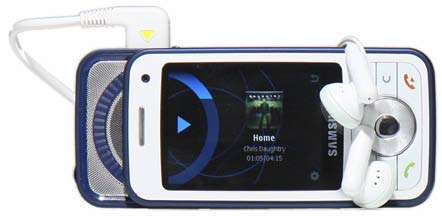 Music on Samsung i450
Market players include telecom operators, handset manufacturers, telecom equipment providers, and applications and content providers, who are constantly innovating and enhancing their offerings for increased revenues.
Mobile music: the most popular of the lot
Without any doubt, mobile music is the most popular of the entertainment services in the Indian market. It has gradually evolved from mono ringtones to advanced services such as ring-back tones, streaming audio and full-track downloads.
Worldwide mobile music revenue stood at $11.7 billion at end-2008 and is forecast to hit $19.2 billion at end-2013.
Music on mobile could be in the form of mobile ringtones, ringback tones, paid-for-full track downloads, subscription-based full track services and music videos. You can purchase the music for outright ownership or subscribe to music libraries for a certain period.
Streaming vs download. While the basic cellphones play music only as ringtones, cellphones touted as ‘music phones’ let you stream or download music files over the Internet via a Wi-Fi connection or 3G cellphone connection. These can also import audio files stored on your PC.
Streaming makes music available on your cellphone in real time, over different types of networks. The audio file is not stored on your cellphone, so in order to listen again, you need to reconnect to the streaming server and initiate (and pay for) another streaming session.
While streaming makes music available in real time, download allows you to enjoy the music repeatedly. Music is stored on the mobile phone, in the built-in memory or on a removable memory stick. However, downloading large music files can take quite some time.
With efforts to increase bandwidth on networks and hence increase streaming/download speeds, entirely new issues arise. Sample one: who will purchase a song on a cellphone when it can be streamed for free, anytime and at any place?
[stextbox id=”info” caption=”Players in mobile music services”]Content providers: Universal Music Group, EMI Music, Sony BMG
Operators: Bharti Airtel, China Mobile, T-Mobile, Vodafone, Verizon Wireless
Aggregators: Buongiorno, Myxer
Vendors: Apple, Sony Ericsson, Motorola, Nokia
Application providers: Musiwave, napster, RealNetworks
Billing providers: Bango, mBlox[/stextbox]
Mobile gaming: next in popularity
Mobile games are video games played on mobile phones. These are growing fast and are expected to become as big a market as mobile music. The value of the worldwide mobile gaming market reached $5.5 billion at the end of 2008 and is expected to grow to $9.8 billion by the end of 2013.
Since Nokia launched Snake on its handsets in 1997, mobile gaming has evolved beyond recognition. Today, various options are available for mobile games. Common ones are:
1. Embedded games. Games preinstalled on the mobile handset; for example, Snake, shipped with Nokia phones


