A tiny chip makes medical wearables smarter with long battery life, low power, and accurate tracking to help keep patients safe and devices reliable.
Demand for connected healthcare wearables is rising fast. The global market for wearable medical devices was around $42.74 billion in 2024 and is expected to reach $168.29 billion by 2030, driven by remote patient monitoring and home healthcare. This rapid growth pushes developers to overcome the unique design challenges of body-worn sensors and discreet medical devices.
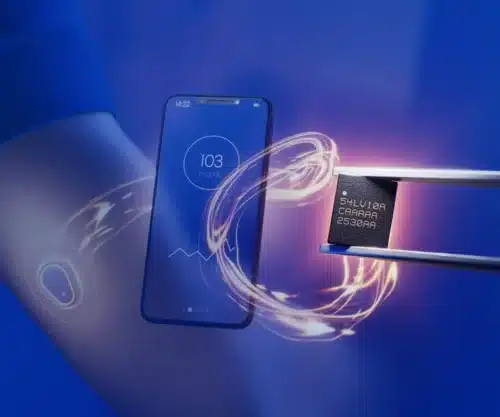
Nordic Semiconductor has introduced the nRF54LV10A SoC. Designed for the smallest medical devices, it delivers high performance, long battery life, and advanced integration. The chip supports low-voltage Bluetooth LE and can run directly from a single silver oxide coin cell, making it perfect for wearable biosensors, continuous glucose monitors (CGMs), and other healthcare devices.
The nRF54LV10A is the fifth member of Nordic Semiconductor’s next-generation nRF54L Series, built for ultra-low power and reliable connectivity in the smallest possible form factor. It supports a 1.2–1.7 V supply, offers a sub-50 nA system hibernation mode for shipping and storage, and comes in an ultra-compact 1.9 × 2.3 mm chip-scale package, the smallest in the nRF54L Series.
Like other nRF54L SoCs, it integrates a 2.4 GHz radio, a 128 MHz Arm Cortex-M33 processor with RISC-V coprocessor, and essential peripherals. The chip provides 1 MB of non-volatile memory and 192 KB of RAM, while consuming 30–50 % less power in common Bluetooth LE use cases than the previous nRF52 Series.
For healthcare applications where data security is critical, the SoC includes advanced features such as secure boot, secure firmware updates, secure storage, and a trusted execution environment powered by Arm TrustZone. Integrated tamper sensors detect attacks and take protective action, and the cryptographic accelerator is hardened against side-channel attacks.
The nRF54LV10A is the first Bluetooth LE SoC to combine low-voltage operation with Bluetooth Channel Sounding. This feature allows developers to add precise distance measurement, indoor positioning, or presence detection—useful in healthcare for tracking a patient’s location through a wearable biosensor to ensure safety.
“The new nRF54LV10A reflects a clear trend in the healthcare segment, engineered to solve some of the key design challenges for next-generation medical devices,” says Oyvind Strom, EVP Short-Range at Nordic Semiconductor.