
With wider voltage flexibility, and higher efficiency targeting servers, telecom gear, and industrial electronics pushing for compact, power-dense designs.
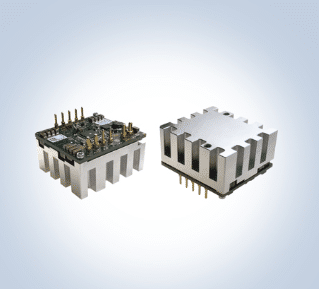
TDK-Lambda has expanded its i7A non-isolated buck converter family with new 1/16-brick models rated up to 1000 W, marking one of the highest power levels available in this footprint class. The update introduces modules supporting 60 A and 80 A outputs and an increase of roughly 82% over earlier versions aimed at designs that need higher current delivery without migrating to larger power stages.
The new entries keep the established mechanical format but add redundant input and output pins to handle the higher current path. This pinout change enables a scalable range from 400 W to 1000 W within the same size envelope. Weight remains low at 85 g, due to a revised baseplate structure intended for applications where mass is a design constraint.
The core specifications include:
- Output power up to 1000 W
- 60 A / 80 A output current options
- 18–60 V input range
- 3.3–28 V adjustable output
- Peak 99% efficiency
Electrical flexibility also broadens. The converters operate from 18–60 V input rails and provide an adjustable 3.3–28 V output, covering common intermediate bus and distributed power architectures. An adjustable output current limit is included to moderate inrush, reduce stress during overload conditions, and support parallel operation when higher combined power or redundancy is required.
Efficiency reaches up to 99%, reducing conduction and switching losses and easing thermal design. To match varied cooling environments, the series is offered in open-frame, baseplate, and heatsink configurations, spanning forced-air, conduction-cooled, and natural-convection systems.
The additions integrate into the broader i7A family, targeting equipment where small form factor, high density, and wide input compatibility are priorities. Target use cases include industrial systems, communications hardware, medical instruments, test and measurement equipment, robotics platforms, drones, and other battery-powered devices.All models comply with IEC/UL/CSA/EN 62368-1 safety standards and carry CE and UKCA marks.