A micro-optics breakthrough enables in-body 3D printing of living tissue using laser-guided bio-inks through a fibre thinner than a pencil lead.
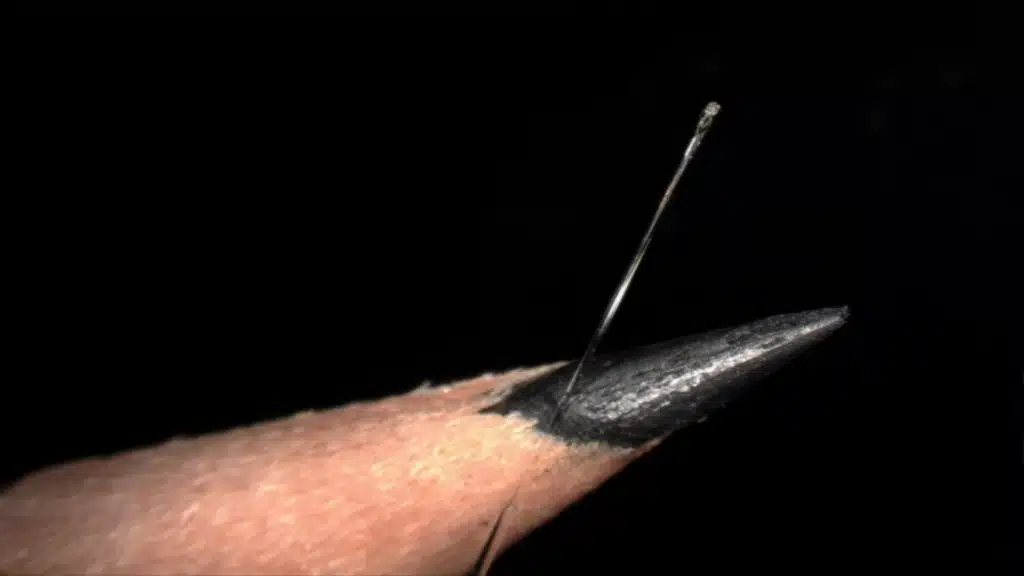
Traditionally, living tissues like cartilage and muscle can be printed, but transplanting them into the body remains a major challenge. These printers cannot operate inside organs, and pre-grown tissue often struggles to integrate once implanted. To solve this, researchers are developing a miniature 3D printer that can directly print living tissue inside the human body.
The device, created by a team at the University of Stuttgart, is designed to travel through thin optical fibres and operate via endoscopic access. The goal is to print complex biological structures exactly where they are needed, without open surgery or external tissue growth.
The core of the system is a light-based 3D printing process. Laser light is guided through a glass fibre, and at its tip sits a 3D-printed lens no larger than a grain of salt. This lens focuses the light to cure layers of bio-ink into living tissue with micrometre-level precision.
Because the light can be shaped and controlled through the fibre, it can print complex cellular structures in confined areas inside the body. The structure of the glass fibre is thinner compared to the tip of a pencil lead.
The team aims to refine the printing resolution and develop biodegradable bio-inks that safely integrate into human tissue. Earlier research, under the EndoPrint3D project, already proved that femtosecond laser pulses can print microstructures through optical fibres. The next step is to combine this capability with biologically compatible materials to make it usable for regenerative medicine.
The project is now part of the Bionic Intelligence Tübingen Stuttgart (BITS) network under Cyber Valley, linking bioengineering, robotics, and AI. The long-term goal is to create a medical tool that can build or repair tissues inside the body using precision photonics and micro-optics.