AI systems use more power as chips heat up. A thin-film material cuts heat at the source and helps hardware run with less energy during operation.
AI systems are driving up electricity use in data centers, mostly because the chips inside these servers generate heavy heat. Cooling thousands of these chips takes huge amounts of power, and this demand keeps rising as AI workloads grow. A major reason is the material inside integrated circuits. Many of these materials store charge and release heat during high-speed operation.
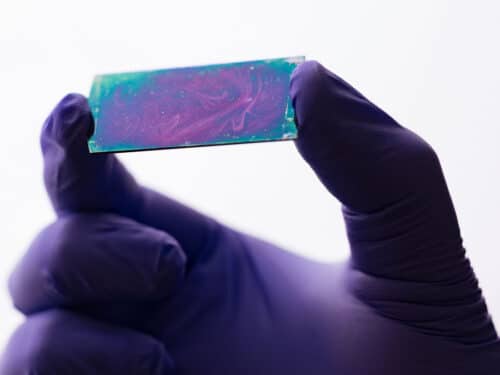
Engineers at the University of Houston have developed a two-dimensional thin-film dielectric made from light-element organic frameworks as a fix to this problem. This film works as an electrical insulator but does not store charge, allowing it to replace the heat-producing parts inside chips. By cutting heat at the source, AI hardware can run faster and depend less on energy-hungry cooling systems.
The thin film is a low-k dielectric, meaning it holds very little electrical energy. Low-k materials help signals move quickly, reduce delays, lower power use, and limit signal interference—all important for high-speed, high-frequency AI computing.
To build the material, the team arranged carbon and other light elements into sheetlike layers with porous crystalline structures. Tests showed that the films have an ultralow dielectric constant, strong breakdown strength for high-voltage use, and good thermal stability at typical device temperatures. These features make the material suitable for high-power environments like AI data centers, where heat and energy use are critical concerns.
The films were produced using synthetic interfacial polymerization, where molecular building blocks meet at the boundary of two liquids that do not mix. At this interface, they link together to form ordered 2D sheets. This approach builds on earlier work in organic framework chemistry and offers a path toward scalable production.