A new browser-based simulation platform is helping engineers accelerate loss and thermal analysis in power electronics design, reducing development time from hours to minutes through rapid virtual verification.
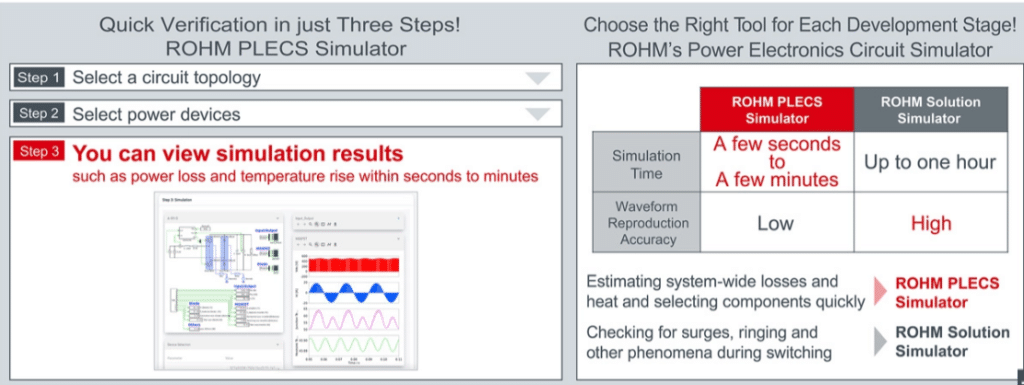
A newly launched online simulation platform by ROHM Semiconductor is set to streamline the early-stage design process for power electronics engineers by enabling rapid verification of circuit performance, thermal behavior, and power losses directly through a web browser.
Designed for power electronics and system designers, the tool focuses on fast and efficient simulation of power devices used in applications such as industrial equipment, automotive systems, and energy infrastructure. Unlike traditional hardware prototyping, which can be both expensive and time-intensive, the simulator allows developers to evaluate device performance virtually within seconds to minutes.
The key features are:
- Browser-based power electronics simulation platform
- Rapid loss and thermal analysis within seconds
- Supports 20 preconfigured circuit topologies
- Compatible with multiple power device selections
- Free access with manuals and application resources
The platform is based on the PLECS simulation environment, a widely used software for modeling and simulating electrical systems involving power conversion and control. Users can select a suitable power electronics circuit topology from a predefined list and pair it with compatible power devices to analyze parameters such as power loss and temperature rise during operation.
The launch addresses a growing need among engineers for quicker device selection during the initial stages of circuit design. Earlier simulation solutions focused heavily on detailed waveform analysis using high-precision SPICE models, which are better suited for advanced verification stages. The new tool complements those workflows by prioritizing speed and ease of use for preliminary analysis.
Currently, the simulator supports 20 different circuit topologies, with plans to expand support for additional device categories including silicon carbide (SiC) components, IGBTs, and power modules. By combining rapid thermal and loss analysis with more detailed waveform verification tools later in the development cycle, engineers can create a more efficient end-to-end simulation workflow.
The simulator is available free of charge through user registration and includes supporting resources such as user manuals and application notes to assist with deployment and operation.
Click here for the original announcement.