




By combining soft materials, cloud-scale simulation, and learning from human motion, researchers are teaching robots to grasp, adapt, and manipulate objects in unpredictable real-world environments—overcoming one of automation’s toughest challenges.
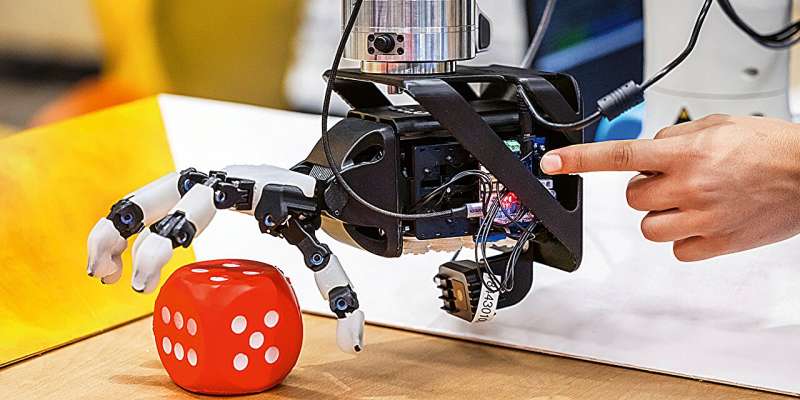
ETH Zurich researchers are advancing robotic manipulation by embedding machine learning and cloud-based training into next-generation soft robotic hands that can adapt to unstructured tasks, a longstanding challenge in automation. Driving the work is a shift from traditional robotics control which relies on rigid models and precise programming to data-driven systems that let robots learn how to grasp and manipulate objects more like humans do.
At the Soft Robotics Lab, led by Professor Robert Katzschmann, robots no longer use conventional motors and rigid joints. Instead, tendon-driven fingers emulate biological softness and flexibility, giving robots high degrees of freedom and agility in handling varied objects in real settings. Central to this evolution are AI models trained on human demonstrations. Researchers use motion-capture gloves and cameras to record human grasping behaviour, then feed that data, sometimes augmented with virtual reality into transformer-based learning models. Once trained, these systems can pick up unfamiliar objects and adjust to changes in position without manual reprogramming.
The approach has led to real-world spin-outs: Mimic Robotics founded by Katzschmann and his doctoral students aims to bring AI-controlled dexterous hands into manufacturing and logistics. Scaling learning in simulation and cloud environments further accelerates progress. At the Robotics Systems Lab, researchers train thousands of robot instances in parallel virtual environments using reinforcement learning, dramatically increasing data throughput compared to physical trials.
However, cloud reliance raises autonomy concerns for robots in disconnected or unpredictable environments, prompting hybrid solutions that embed pre-computed knowledge onboard. Other ETH teams combine learned data with physics-based models to reduce data needs and increase adaptability in complex tasks, such as object sorting or dynamic manipulation. By blurring the line between robot “brains” and bodies, ETH’s work is pushing robots toward more human-like generalisation promising broader application in industry and beyond.
