





Researchers at Science Tokyo demonstrate how low-cost analog repeaters can overcome mmWave signal blockages, enabling stable 5G and 6G connectivity in dense urban zones.
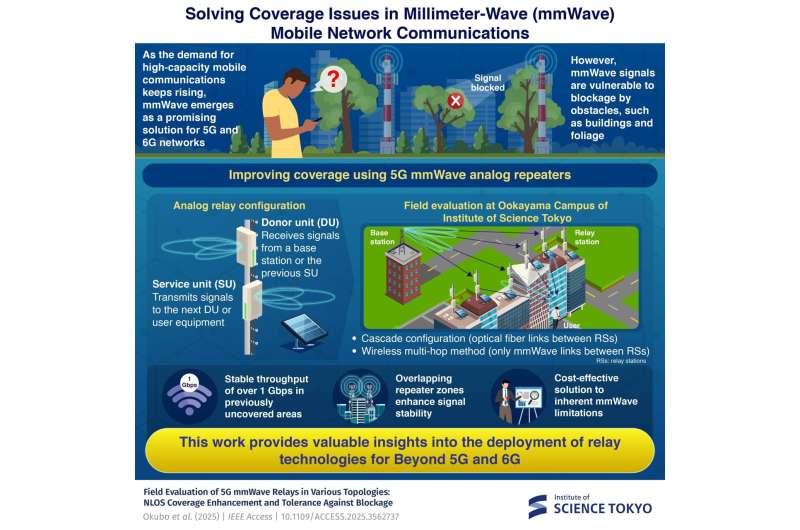 This study introduced a cost-effective solution to address the mmWave limitation of blocking, paving the way for faster and more stable mobile communications. Credit: Institute of Science Tokyo
Millimeter-wave (mmWave) technology has long promised ultra-fast, low-latency mobile communication—key for applications like augmented reality and autonomous vehicles. But in real-world deployment, mmWave has hit a wall—literally. High-frequency mmWave signals are easily blocked by buildings, trees, or even people, making widespread coverage both technically complex and cost-prohibitive.
Now, researchers at Science Tokyo may have cracked the code. A team led by Professor Kei Sakaguchi from the Department of Electrical and Electronic Engineering has shown that low-cost analog repeaters could be the missing link to bring mmWave to life in practical urban settings. The findings, published in IEEE Access, detail a successful demonstration on the university’s Ookayama Campus using repeaters to extend mmWave coverage into hard-to-reach, non-line-of-sight (NLOS) zones.
In the field test, researchers deployed analog repeater pairs—each with a donor unit to receive and a service unit to retransmit mmWave signals. Two setups were tested: a fiber-connected cascade configuration and a fully wireless multi-hop relay chain. Both achieved stable connections with throughput exceeding 1 Gbps—even in previously unreachable areas.The cascade model showed slightly higher data rates, while the wireless multi-hop system delivered more consistent signal quality. Importantly, both methods vastly outperformed traditional base stations alone when it came to mmWave coverage.
One standout feature was the concept of “distributed relay diversity.” Overlapping coverage zones from multiple repeaters helped maintain signal integrity even when obstacles—like a walking person—blocked direct transmission paths. This artificial multipath environment boosted reliability and throughput, which is critical in dense, high-traffic areas.“Our results demonstrate that proper placement of analog repeaters can overcome mmWave’s inherent blocking loss,” said Sakaguchi. “This is a big step toward practical Beyond 5G and 6G networks.” With mobile data demand skyrocketing, this analog repeater approach could be the key to finally delivering on mmWave’s full promise.
