

A full microwave transmitter on a monolayer of molybdenum disulfide, achieving ultra-low power use, minimal signal loss, and dual radar–communication capability—signaling a development for compact, energy-efficient wireless and robotic systems.
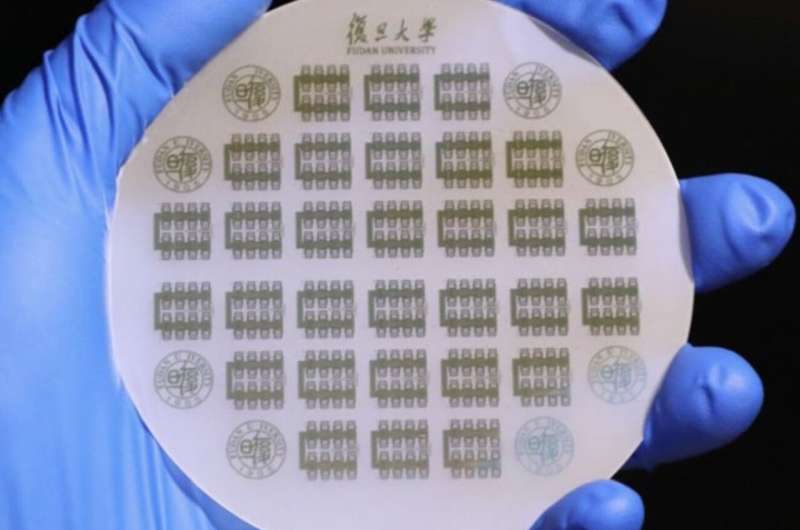
In a leap toward next-generation wireless communication, researchers at Fudan University have created a microwave transmitter built entirely on monolayer molybdenum disulfide (MoS₂). The atom-thin system demonstrates both exceptionally low power consumption and energy loss—key advances for shrinking and improving high-frequency communication electronics.
Microwave circuits, operating across frequencies from 1–300 GHz, form the foundation of wireless networks, radar, and satellite systems. Yet, conventional transmitters made from bulk materials such as silicon or gallium arsenide struggle with miniaturization and energy efficiency. As the global demand for compact, power-conscious communication grows, engineers are looking to two-dimensional (2D) semiconductors for answers.
Among these materials, MoS₂ stands out for its combination of atomic thinness and high carrier mobility. The Fudan team, led by Tianxiang Wu and Liyuan Zhu, fabricated 30 integrated microwave transmitters directly on a four-inch MoS₂ wafer—the first demonstration of its kind. Their design arranges 16 transmitting elements in a 4×4 grid capable of electronic beam steering.
The prototype achieves a transmission loss of just 0.51 dB per switch and consumes only 3.2 μW in total operation. With a 6 GHz bandwidth and a beam scanning range of −35° to 35°, it can transmit signals over 136 meters while maintaining a 26-day standby time on a 1,000 mAh battery.Beyond efficiency, the MoS₂ transmitter’s dual-mode capability enables simultaneous communication and radar functions—an increasingly valuable feature for autonomous systems. Its miniature, 3 × 2 cm² board can even integrate into small robotic or insect-scale platforms, underscoring its potential in wearable electronics and untethered microsystems.
By merging 2D semiconductor physics with practical microwave design, this work charts a new path for energy-frugal, high-frequency electronics. Future iterations could extend into low-power Internet-of-Things (IoT) devices, compact sensors, and bio-inspired robotics. As Wu and colleagues note, their achievement marks “a significant step toward integrated 2D microwave systems” that could redefine the balance between performance, scale, and power in modern communications.