




What if sunlight, water, and carbon dioxide could create usable fuel without batteries, controllers, or complex energy storage systems?
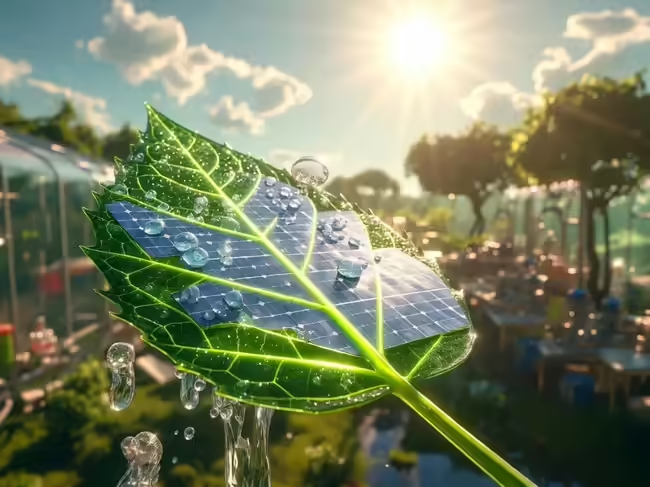
Researchers at Osaka Metropolitan University have developed a battery free artificial photosynthesis system that continuously converts sunlight, water, and carbon dioxide into formic acid, a liquid fuel and energy storage chemical.
Artificial photosynthesis aims to mimic how plants convert sunlight into usable energy. Conventional systems typically combine solar panels with electrolysers that transform carbon dioxide and water into fuels. However, fluctuating sunlight often requires batteries and electronic control systems to maintain stable operation, adding complexity and cost.
The newly developed system eliminates that requirement through a self regulating electrolyser design. Instead of relying on batteries or conventional maximum power point tracking electronics, the platform uses a chemical control mechanism that automatically adapts to changing sunlight conditions. This allows the system to operate directly from solar power while maintaining continuous fuel production.
The approach offers several advantages. Removing batteries can reduce system cost, simplify deployment, lower maintenance requirements, and improve long term reliability, particularly in remote or unmanned installations.
At the core of the system is a three compartment electrolyser that combines carbon dioxide and water to produce formic acid. The setup is powered directly by photovoltaic panels through a DC DC converter and uses low power components such as piezoelectric pumps and an energy efficient microprocessor.
Formic acid is attracting attention as both a liquid fuel and a hydrogen carrier because it stores energy in chemical bonds and can be produced from captured carbon dioxide. By converting solar energy directly into a storable chemical fuel, the system provides an alternative pathway for renewable energy storage beyond conventional batteries.
“The technology demonstrates a pathway toward simpler and more scalable solar fuel production by eliminating the need for battery based control systems,” the research team noted.
