OLED screens are thin but not very bright. A new design now makes them twice as bright without adding thickness, improving phones and tablets.
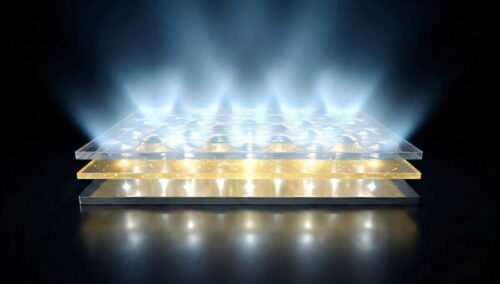
Organic light-emitting diodes (OLEDs) are widely used in smartphones and TVs for their excellent color and thin, flexible design. However, internal light loss has limited brightness improvements. KAIST researchers have now developed a technology that more than doubles OLED light-emission efficiency while preserving the flat structure that makes OLED displays advantageous.
OLEDs consist of multiple layers of ultrathin organic films stacked together. As light passes through these layers, repeated reflection and absorption often cause more than 80% of the generated light to be lost as heat before it can escape.
Traditional methods to improve light extraction, such as hemispherical lenses or microlens arrays (MLAs), have limitations. Hemispherical lenses protrude significantly, making it difficult to maintain a flat form factor, while MLAs require coverage larger than individual pixels to achieve sufficient light extraction. This can create interference between neighboring pixels and limit efficiency.
To address these challenges, a new design strategy was developed to maximize light extraction within the size of each individual pixel. Unlike conventional approaches that assume OLEDs extend infinitely, this method accounts for finite pixel sizes used in real displays, enabling more light to be emitted externally from each pixel.
A near-planar light outcoupling structure was also introduced to direct light efficiently forward without spreading it excessively. This structure is thin—comparable to existing MLAs—yet achieves light extraction efficiency close to that of hemispherical lenses with the same lateral dimension. It preserves the flat form factor of OLEDs and can be applied to flexible displays.
Combining the new OLED design with the near-planar outcoupling structure more than doubled light-emission efficiency, even in small pixels. The technology allows brighter displays using the same power, reduces heat generation, and is expected to extend battery life in devices such as smartphones and tablets. Improvements in display lifespan are also anticipated.
This approach is not limited to OLEDs and can be applied to next-generation displays based on materials such as perovskites and quantum dots.