





By using topological waveguides, the circuits allow phonons to travel smoothly around corners and defects, offering a robust platform for future hybrid electronic–photonic–acoustic systems.
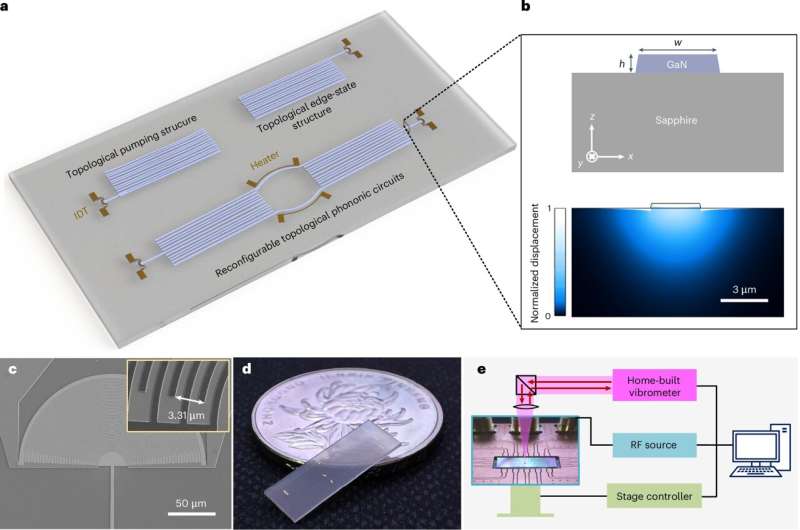
Researchers at University of Science and Technology of China, Penn State University and other institutes have demonstrated compact phononic circuits that can guide sound waves at 1.5 GHz, opening the door to chip-scale devices for communications, sensing, and quantum technologies.
Phononic circuits manipulate sound waves—phonons—much like electronic circuits control electrons or photonic circuits direct light. Unlike bulky acoustic devices of the past, these new platforms confine and steer vibrations through microscopic waveguides patterned on chips. Importantly, the circuits exploit topological pathways, allowing sound to move smoothly even around corners or through defects without scattering.

The ability to operate at gigahertz frequencies makes these circuits directly compatible with existing microwave systems, a key requirement for real-world applications. Such GHz phonons oscillate billions of times per second, aligning them with technologies ranging from 5G and beyond communications to quantum processors.
To test their design, the researchers used a custom-built optical vibrometer to map how sound propagated through the chip. Experiments confirmed that phonons injected into the edge channels traveled reliably, maintaining coherence. A Mach–Zehnder interferometer test further demonstrated reconfigurability, showing the circuits could dynamically alter phonon pathways—an essential feature for signal processing and information handling.The platform’s scalability could allow mass fabrication on standard substrates, making it a practical option for integration into hybrid systems. Potential applications include advanced acoustic filters, precision sensing devices, and phonon-based components for emerging quantum information systems.
“Our phononic circuits are like microscopic highways that guide sound instead of light,we want to build a full phononic toolbox for advanced information processing, by arranging the waveguides in special patterns, we create topological routes where sound flows robustly, even in imperfect conditions”, explained Mourad Oudich, co-first author.
The team aims to merge phononic devices with electronic and photonic platforms. With its combination of compactness, robustness, and GHz operation, this phononic technology marks a step toward practical chip-scale sound-based devices that complement existing electronics and photonics.


