




New lithium-metal film design cuts early battery capacity loss and could increase electric vehicle driving range by around 20% while simplifying manufacturing.
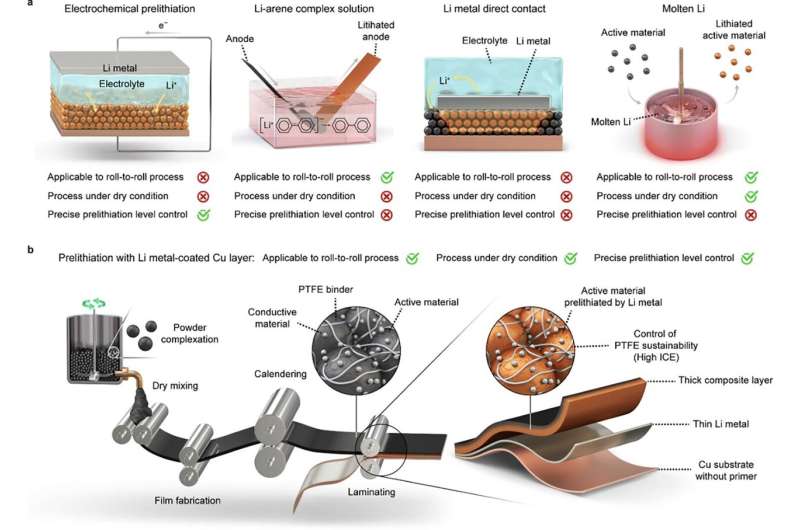
Electric vehicle batteries may be on the cusp of a practical range boost thanks to a new dry-electrode manufacturing technique that could cut early performance losses and simplify production. JooHyeon Heo, Ulsan National Institute of Science and Technology, South Korea have developed a dry-process electrode that uses a thin lithium metal film to address a long-standing hurdle in high-capacity lithium-ion cells.
Traditional EV battery electrodes are made in wet-chemistry processes using solvents that later have to be removed, adding cost and complexity. Dry electrodes attractive because they eliminate toxic solvents and reduce manufacturing steps have struggled with significant capacity loss during the first charge cycle, especially when the electrode layer is thickened to increase energy storage.
The new approach replaces the usual primer layer between the anode’s active material and the copper current collector with a very thin lithium-metal film. This layer not only helps particles stick together but also supplies additional lithium directly into the active material as the battery begins cycling, offsetting initial losses. In tests, batteries built with these dry thick electrodes showed about 75 % less capacity loss in early use compared with conventional equivalents.
For EVs, that improvement matters: the researchers estimate a roughly 20 % increase in real-world driving range from cells incorporating this technology. Beyond performance gains, the new process streamlines production by combining electrode adhesion and prelithiation a preparatory lithium infusion step into a single operation that could fit into existing high-volume roll-to-roll manufacturing lines.
Battery makers have long sought to boost energy density without compromising lifecycle or cost. Thick electrodes theoretically store more energy per unit area, but practical issues with binding and early capacity fade have limited adoption. This dry film concept tackles both adhesion and lithium deficit in one go, potentially logging gains without extra processing steps.
Industry interest in dry coating isn’t new major EV battery developers have publicly pursued dry-electrode processes as a path to cheaper, more sustainable production. If the new technique scales as hoped, it may add to broader efforts to push EV battery performance and lower costs ahead of next-generation solid-state or alternative chemistries.


