





A new class of compact compute module integrates heterogeneous processing with industrial-grade resilience, tackling demanding AI and graphics workloads at the edge.
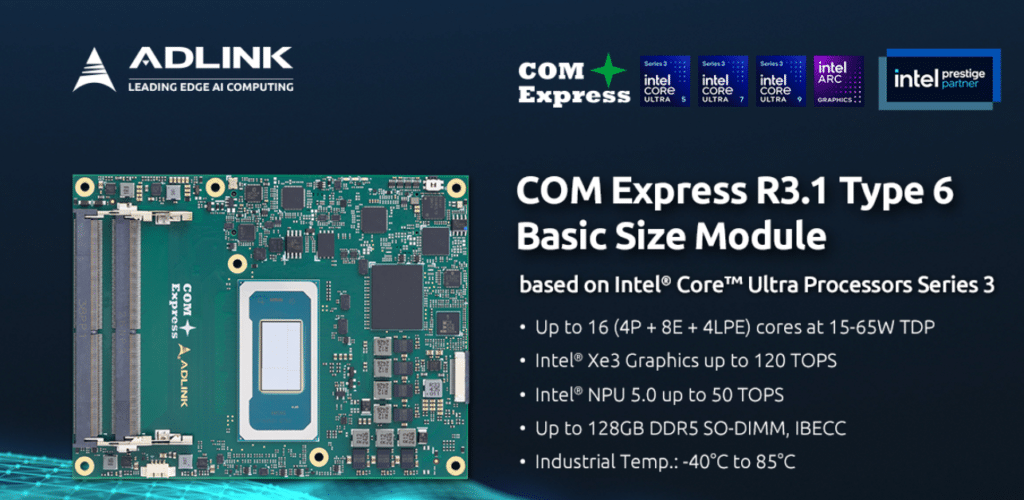
ADLINK has rolled out its latest computer-on-module platform built on Intel’s newest high-performance processors, marking a notable step in embedded computing aimed at AI-intensive and ruggedised applications. Positioned for deployment in sectors such as industrial automation, autonomous robotics, and advanced imaging, the new module leverages the advanced hybrid architecture and AI capabilities of Intel’s Series 3 platform to deliver a substantial boost in combined compute, graphics, and neural processing performance.
The key features are:
- Up to 180 TOPS combined AI performance (GPU + NPU) for demanding edge workloads.
- Integrated high-performance graphics and neural compute (up to 12 Xe cores, 50 TOPS NPU).
- Hybrid CPU architecture with performance, efficiency, and low-power cores.
- Support for up to 128 GB DDR5 with IBECC and robust industrial networking.
- Extended temperature and rugged specs for mission-critical and outdoor applications.
At its heart is a heterogeneous computing stack that blends performance, efficiency, and low-power cores alongside next-generation graphics and neural acceleration hardware. With up to 180 TOPS of total system performance including dedicated GPU and NPU contributions the module is engineered to run complex AI inference and graphics workloads locally, reducing reliance on discrete accelerators and external co-processors.
Memory and I/O capabilities have been scaled to match this compute muscle. Support for up to 128 GB of DDR5 with error-correcting options ensures low-latency, reliable operation under heavy system loads, while industrial features such as time-sensitive networking (TSN) and extended temperature specifications make the design suitable for mission-critical environments.
Beyond raw performance, the module’s design emphasizes integration ease and versatility. Graphics performance crucial for display-centric embedded systems like medical imaging or infotainment is handled by Intel’s latest graphics architecture, which offers significantly higher throughput and simplified system design compared to prior generations.
The platform’s rugged variants are validated for extreme environments, with operating ranges from –40 °C to 85 °C and industrial-grade memory safeguards, addressing the needs of outdoor systems, automation equipment, and other hard-use cases where reliability is essential. The initial modules are expected to arrive in the second quarter of 2026, with kit-level support to accelerate prototyping and integration for OEMs and system designers.

