What if circuits could be drawn like pencil marks, work on almost any surface, and then be erased and reused when no longer needed.
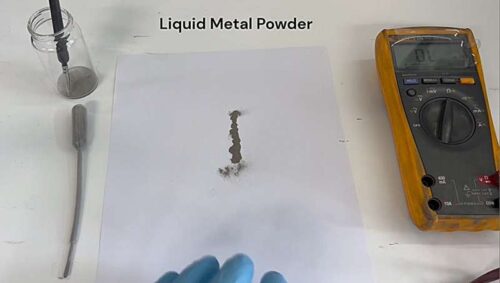
Researchers at the Electronics and Telecommunications Research Institute (ETRI) have developed a method to draw electronic circuits directly on surfaces using a pencil-like material made from liquid metal powder. The material becomes conductive when pressed, allowing circuits to be formed on paper, plastic, glass, textiles, and plant leaves without heating or complex processing. It can also be recovered and reused after use.
The approach uses liquid metal in the form of fine powder particles. Each particle is enclosed by a thin oxide layer that forms naturally when exposed to air. In this state, the powder does not conduct electricity. When mechanical force is applied, such as brushing or pressing, the oxide layer breaks, enabling the particles to connect and form a conductive path. This allows circuits to be activated only where needed, avoiding unwanted spreading.
Conventional liquid metals have high surface tension and low wettability, which makes precise placement difficult. They tend to spread or clump and often require additional surface treatment. Converting the material into powder form improves control and addresses these limitations.
The method supports circuit formation on a wide range of surfaces without additional processing. It reduces issues such as pattern distortion and instability, enabling more consistent circuit creation across different materials.
Examples include skin-mounted health monitoring devices and flexible circuits for soft robots. The process does not require complex equipment, supporting use in wearable systems and flexible electronics.
The material can also be recovered after use. Circuits can be dissolved in water and treated chemically, such as with sodium hydroxide, to extract the liquid metal. The recovered material can be converted back into powder and reused.
The powder remains stable over time, maintaining performance after more than a year at room temperature and after repeated bending or twisting. This supports use in temporary circuits and systems that can be reconfigured or removed after use.