Neurons that use both light and electricity could change how machines compute and communicate. A new discovery brings us closer—want to know more?
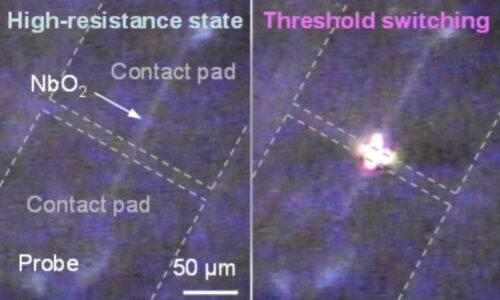
Researchers at Stanford University, Sandia National Laboratories, and Purdue University have developed electro-optical Mott neurons that generate neuron-like electrical pulses while producing light. Each spike carries both an electrical and optical signature, synchronized in time, marking the first observation of electro-optical synchronization in neuron-inspired devices. This dual-domain capability allows computation and communication in a single element, removing the need for separate light sources or energy-intensive signal conversions.
Most neuron-inspired devices process signals using either electrons or photons, but rarely both, because of the challenges and energy costs of converting between the two. In contrast, these electro-optical neurons produce electrical spikes with visible light pulses, which could allow long-range optical signaling synchronized with local electrical computation.
Eric Pop, co-senior author, explained, “This work began as a simple study of switching in niobium dioxide (NbO2) devices. While optically monitoring them for signs of electrical breakdown, we noticed an unexpected, bright visible glow from the NbO2 channel.”
Mahnaz Islam, first author, added, “We started with thin films of NbO2 deposited by sputtering, then used standard fabrication techniques to make micrometer-scale devices with two metal contacts.”

The devices are based on thin films of niobium dioxide (NbO₂) fabricated into micrometer-scale structures with two metal contacts. During electrical switching, the NbO₂ channel emits visible light, first observed during optical monitoring of electrical breakdown. The emission occurs in visible-range wavelengths and aligns with electrical oscillations, which the team traced to an electronic origin.
This approach could affect multiple fields. In metrology, synchronized electrical and optical spikes can probe correlated electron systems in real time. In computer vision, the neurons could integrate directly with optical sensors for in-sensor processing. For electro-optical computing and communication, dense neuromorphic systems could use optical pulses for long-range connections while electrical states handle local computation and memory.
Future work aims to scale these devices into larger arrays and improve light management. Possible enhancements include on-chip waveguides, higher-quality material samples, passivating non-radiative defects, adding luminescent centers to tune emission, and optimizing geometry to increase light extraction.