

AI infrastructure is becoming more power-efficient as system-level advances in compute, memory, interconnects, and software raise performance per watt for large-scale workloads.
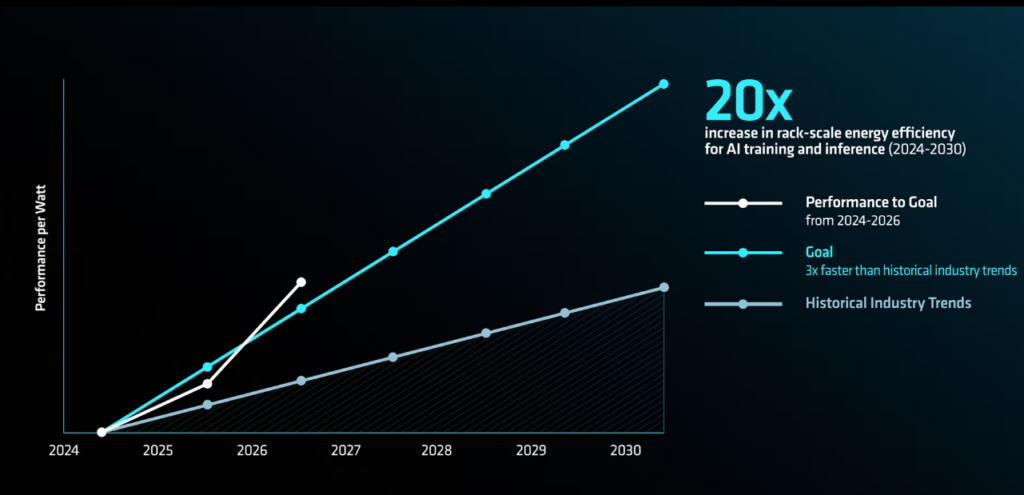
AMD has achieved an estimated 4x improvement in AI energy efficiency by mid-2026, surpassing its projected 3x milestone and putting its rack-scale AI infrastructure on pace for a 20x improvement by 2030, compared with a 2024 baseline. The measurement covers AI training and inference and reflects improvements across the complete computing system rather than a single processor.
The efficiency strategy combines advances in compute silicon, memory, interconnects, software, and rack-level system design. This approach is increasingly important as AI workloads require processors to handle larger models and move substantially more data between compute, memory, and networking components. Improving performance per watt can allow data centers to deliver more useful computation without increasing energy consumption at the same rate.
The technology optimises AI computing for higher performance per watt while combining high-bandwidth memory with larger cache architectures to improve data access and processing efficiency. High-speed scale-up interconnects support faster communication across rack-scale systems, while hardware-software co-design through ROCm helps optimise overall AI workload execution. These improvements contribute to the company’s target of achieving 20x higher rack-scale energy efficiency by 2030.
At the compute level, process technology and architectural improvements are being used to increase floating-point performance per watt. Memory is another major factor: higher bandwidth, high-bandwidth memory, larger caches, and closer integration between memory and compute can reduce inefficient data movement while keeping AI accelerators supplied with data.
Interconnects also influence rack-scale efficiency. As AI systems combine larger numbers of CPUs, GPUs, and other components, high-speed connections can reduce communication bottlenecks and move data more efficiently across the system.The company is combining these hardware improvements with software optimisation through its ROCm software stack, open standards, and hardware-software co-design.
AMD projects that continued gains could allow approximately two racks in 2030 to provide the same compute as 570 racks based on 2024 configurations for a representative AI training workload. Under this scenario, use-phase electricity consumption could fall by 20x and carbon intensity by 28x. Alternatively, the same energy could support up to 20x more compute, measured in floating-point operations per second per watt. The efficiency gains are aimed at addressing practical data-center constraints, including electricity demand, cooling capacity, infrastructure availability, and total cost of ownership. AMD notes that its 2026 progress combines measured product data with modeled estimates where final performance data was not yet available.