





A new terahertz-band wireless testbed breaks ground by reliably transmitting ultra-wideband, 5G-compliant signals under emulated speeds up to 1,000 km/h a key technical step toward practical 6G electronics and signal processing.
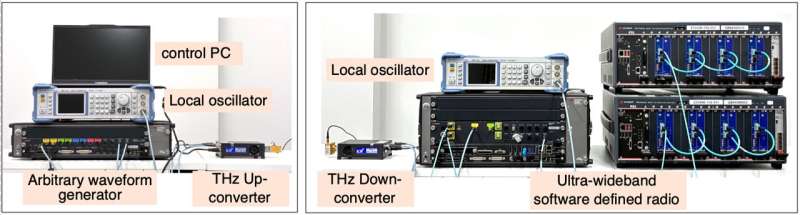
Researchers at Kyoto University have pushed the frontiers of high-frequency wireless communications by successfully demonstrating a terahertz (THz)-band transmission testbed that sustains stable data delivery under extreme motion scenarios equivalent to speeds of up to 1,000 km/h far beyond typical terrestrial use cases.
The breakthrough targets a core challenge for future 6G-era electronics and wireless systems: how to harness the enormous bandwidth available at terahertz frequencies, substantially higher than the millimetre waves used in current 5G networks, without sacrificing signal integrity or compliance with established communication standards. Terahertz bands offer gigahertz-wide channels roughly 20 × wider than the maximum 5G channel bandwidth but introduce complexities in signal processing, frequency stability and mobility tolerance that must be solved before viable systems can be built.
To tackle this, the team led by Hiroshi Harada and Yusuke Koda developed a lab-based, software-defined radio testbed capable of transmitting ultra-wideband signals in the THz spectrum while adhering to key 5G transmission specifications. They then evaluated how well these signals performed as they artificially ramped up simulated receiver speeds an emulation of environments ranging from stationary links to high-velocity platforms such as aircraft or high-speed vehicles.
Performance was measured using block error rate (BLER), a standard metric in wireless communications that captures how often errors occur in received data blocks. Under conventional signal processing methods designed for lower-frequency bands, the threshold BLER of 10% was not met once the emulated speed exceeded roughly 700 km/h. However, by integrating a new processing approach tailored for terahertz dynamics, the researchers maintained acceptable BLER performance across the full range of tested speeds establishing robust transmission even at the highest mobility rates.
This achievement paves the way for practical evaluation and refinement of THz-based communication electronics, essential for future 6G networks and beyond, where ultra-high data rates and broad coverage scenarios from fixed wireless backhaul to non-terrestrial aerial and space links are anticipated.


