




The circuit breaker stops power faster. It helps save energy, prevent fires, and makes DC power better for data centers, solar, and the grid.
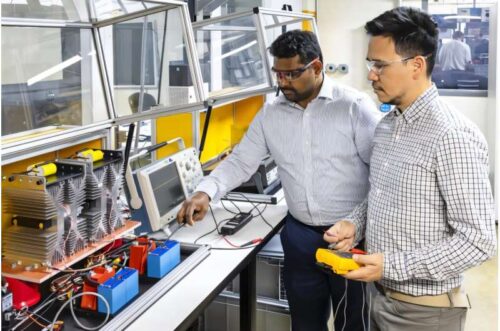
Researchers at Oak Ridge National Laboratory have developed a new type of circuit breaker that operates up to 100 times faster than traditional mechanical ones. This could reduce electricity costs and increase capacity across the US power grid. The innovation is designed for medium-voltage direct current systems and could enable a more efficient and reliable energy infrastructure.
Unlike alternating current, which naturally pauses 60 times per second and is easier to interrupt, direct current flows in one direction continuously. This makes it harder to stop during a fault and raises the risk of overheating or fire. Traditional mechanical breakers are too slow to handle this kind of current safely.
The new breakers rely on semiconductor components instead of moving parts. By switching currents in under 50 microseconds, these solid-state devices can quickly shut down dangerous faults, reduce electrical arcing, and improve safety. They also eliminate the need to convert direct current to alternating current, reducing transmission losses and supporting advanced energy applications such as AI data centers, renewables, and bidirectional power flows.
Key to this breakthrough is the use of thyristors, cost-effective semiconductor devices previously considered too limited for medium-voltage direct current. ORNL engineers overcame their constraints by designing external circuits to suppress current flow. In tests, their prototype safely interrupted a 1400-volt current far faster than previous designs.
To support even higher voltages, multiple breakers were linked in series. This posed engineering challenges in voltage balancing and maintaining fast switching. The team addressed both issues and successfully tested a system at 1800 volts. Work is already underway to scale the technology up to 10000 volts for future direct current grids.
This development could pave the way for wider use of direct current power in grid applications. It offers more efficient energy delivery, better integration with digital systems, and stronger support for growing electricity demands.


