





New ferroelectric memory breakthroughs improve energy efficiency and storage density, offering promising pathways for next-generation AI and data-intensive computing systems.
Imec has announced significant progress in ferroelectric memory research, highlighting two complementary innovations aimed at supporting the next generation of AI-driven computing systems. As artificial intelligence workloads continue to increase the demand for memory capacity, bandwidth, and energy efficiency, researchers are exploring alternatives to conventional memory technologies such as DRAM and SRAM.
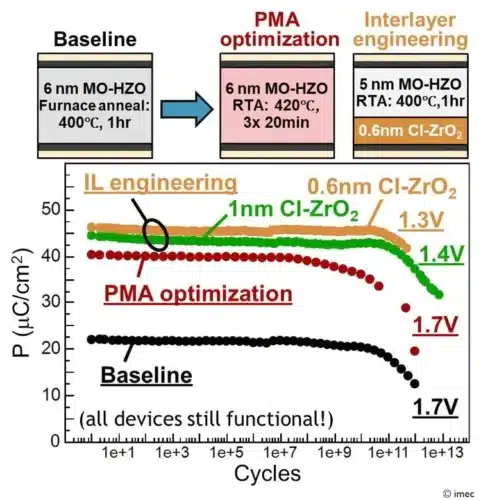
The first breakthrough involves ferroelectric capacitors designed for low-voltage operation. Researchers demonstrated that these capacitors can function at approximately 1.3 volts while maintaining high remnant polarization and endurance exceeding 10 trillion cycles. These characteristics make them promising candidates for future DRAM-like memory applications that require both performance and energy efficiency.
The second development focuses on vertically stacked ferroelectric field-effect transistors (FeFETs), which could enable highly compact and dense memory architectures. Imec successfully demonstrated a five-word-line vertical stack of FeFET memory cells, increasing storage density by stacking devices on top of each other. The research also introduces a dual-gate configuration that improves erase efficiency, addressing a key challenge associated with FeFET technology.
According to Imec, both innovations rely on similar ferroelectric material stacks, allowing insights gained from one technology to support improvements in the other. The combination of low-voltage ferroelectric capacitors and high-density FeFET structures could provide new pathways for scalable 3D memory solutions.
The advances arrive at a critical time for the semiconductor industry as traditional memory technologies approach scaling limitations while AI applications require increasingly larger and more efficient memory systems. Ferroelectric capacitors offer energy-efficient operation, while vertically stacked FeFETs provide compact storage suitable for embedded and next-generation computing architectures.
Imec researchers believe these complementary approaches can help address future performance and cost challenges in data-centric systems, supporting the continued growth of AI and other memory-intensive applications.

