Flexible lithium-ion fiber batteries, a promising power source for smart clothing and integrated electronics face two fundamental challenges before they can become practical for consumer and wearable electronics.
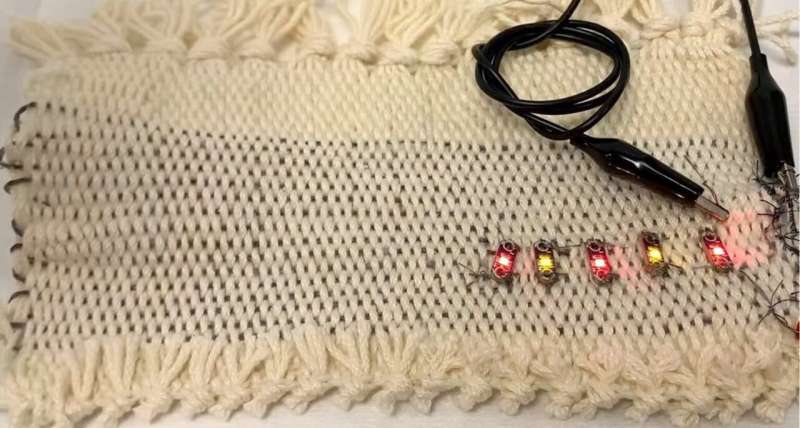
Researchers are intensifying efforts on fiber-shaped batteries that could be woven directly into garments and textiles and serve as flexible power sources for wearable electronics, health monitors and other “smart” fabrics. But a new review highlighted by North Carolina State University researchers two major technical obstacles that must be solved before these batteries can graduate from lab curiosities to real-world applications.
Unlike traditional rigid cells, fiber lithium-ion batteries are designed as yarn-like strands that can bend, twist and integrate seamlessly with fabrics. That flexibility makes them attractive for next-generation wearables where conventional power packs don’t fit. However, the latest analysis shows that researchers still must overcome hurdles in both protecting the batteries and predicting their behaviour accurately.
The first challenge is encapsulation. In standard batteries, solid casings keep oxygen and moisture out of intrusion that accelerates degradation and reduces performance. For fiber batteries, the encapsulating material must not only block these elements but also remain flexible and fabric-like so it can be woven into clothing. In tests of several protection strategies from simple polymer tubes to liquid metal layers each method showed some advantages but still failed on key metrics such as water-vapor transmission, longevity and electrical performance. Even the most promising liquid metal approach proved too complex and costly for practical use.
The second issue lies in modelling and design prediction. Researchers use mathematical models to estimate how changes in battery chemistry and length affect output. Although longer fiber batteries generally yield more energy, existing models struggle to accurately forecast performance across varying lengths and material choices. Better models would help designers optimize battery geometry and chemistry for real products, instead of relying mostly on trial-and-error experimentation.
Solving these problems will likely require multidisciplinary input, with expertise from packaging technologies and advanced electrochemical modelling. Until that happens, the vision of fully integrated power-generating textiles remains promising but technically incomplete. Wearable electronics are expanding into health, fitness, augmented interfaces and beyond. Flexible, fabric-embedded batteries that can power sensors and devices without bulky packs would be a major step forward but only if engineers can protect them from the environment and reliably design them at scale.