





Can a solar cell thinner than human hair survive deep space radiation? Researchers demonstrate exceptional durability in ultra flexible designs.
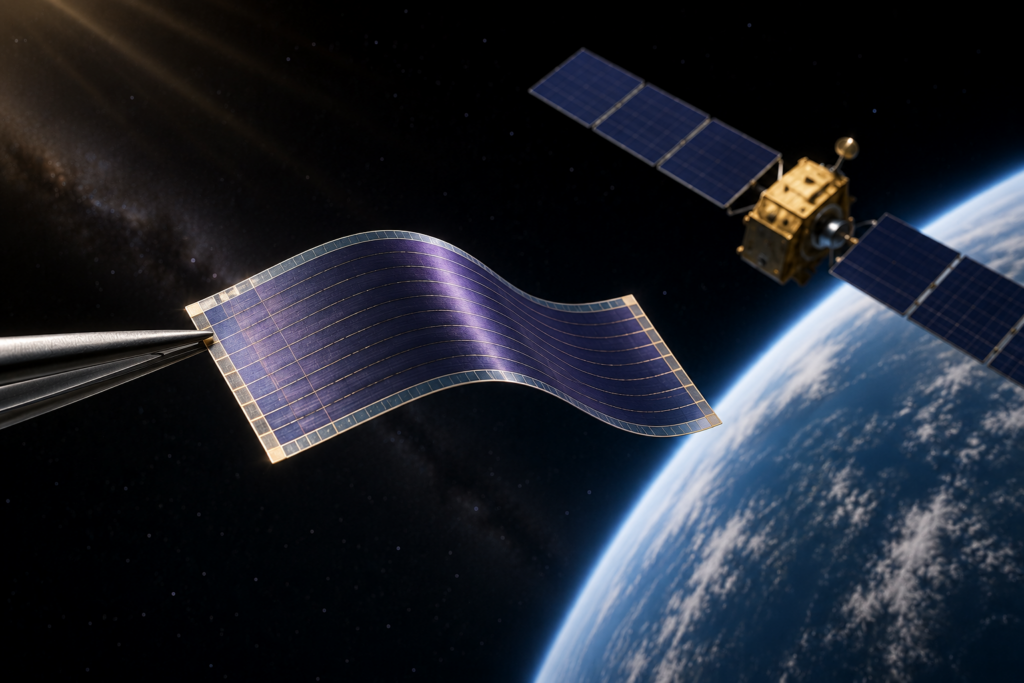
Researchers at the Institute of Space and Astronautical Science (ISAS) have developed an ultrathin perovskite solar cell that maintains performance even after exposure to radiation levels far exceeding typical space requirements.
The solar cell, just 4 microns thick, was tested under gamma ray irradiation of 890 krad, more than ten times the standard radiation level used for space qualification. The results suggest that ultrathin perovskite devices could serve as lightweight power sources for future satellites and deep space missions.
The key advantage lies in the combination of flexibility, low weight, and radiation tolerance. Conventional space solar cells often require protective layers that add mass and limit deploy ability. The newly developed design retains nearly all of its original performance after irradiation, enabling thinner and lighter solar arrays that can be folded during launch and deployed once in orbit.
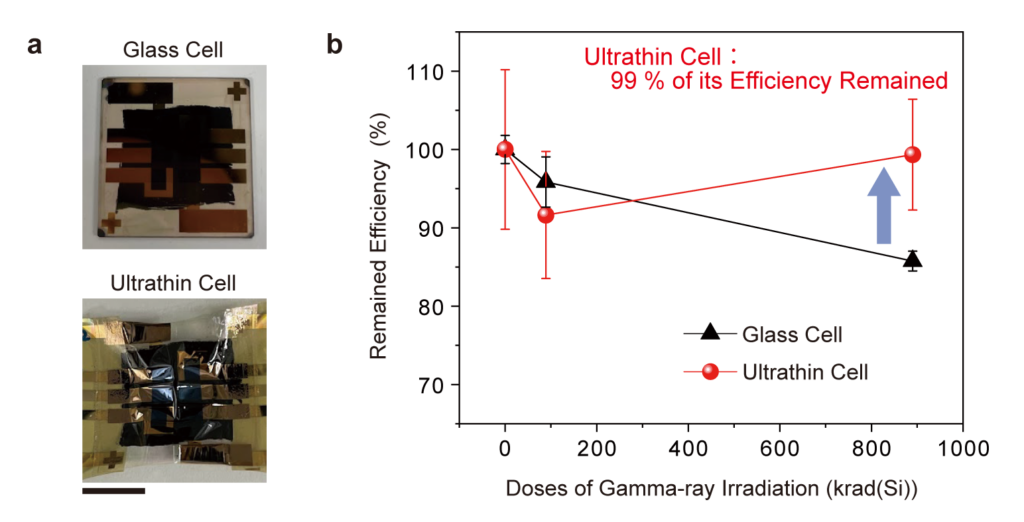
(a) Device photographs of glass substrate and ultrathin substrate perovskite solar cells after 890 krad gamma-ray irradiation. Scale bar: 1 cm.
(b) Dose dependence of efficiency retention rate of perovskite solar cells fabricated on glass substrate and ultrathin substrate, respectively. Modified from H. Jinno & et al., Solar RRL, 2026 (CC BY 4.0).
To achieve this, the team used a flexible radiation resistant substrate made from parylene and SU 8 instead of conventional glass. While comparable perovskite solar cells built on glass retained only 86% of their initial efficiency after irradiation, the ultrathin version maintained 99% of its original performance. Researchers found that the flexible substrate avoided radiation induced discoloration that typically reduces solar cell output.
The device structure is between ten and one hundred times thinner than conventional thin film space solar cells. Its lightweight construction also removes the need for glass protective films, helping maximise flexibility while reducing launch mass.
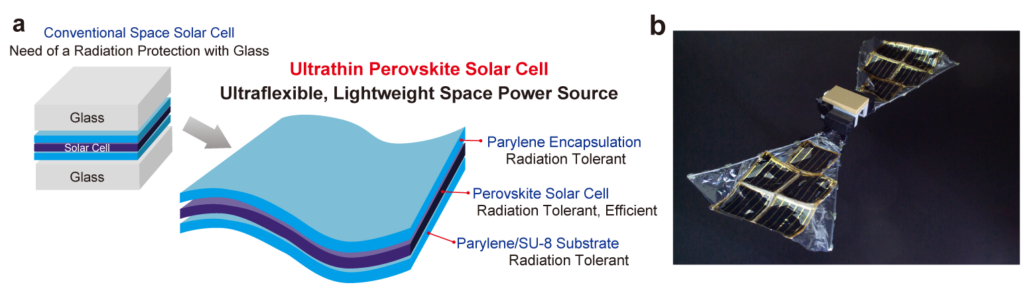
(a) Differences between the radiation-resistant ultrathin perovskite solar cell developed in this study and conventional solar cells.
(b) Future spacecraft prototype using ultrathin solar cells. A large-area, flexible solar panel deploys from the main body and generates electricity.
The researchers believe the technology could support large deployable solar panels for small satellites and future deep space missions where lightweight, high area power generation is essential.
According to the research team, the achievement demonstrates that ultrathin perovskite solar cells can maintain high radiation resistance while preserving the flexibility needed for next generation space power systems.

