The devices could store three times more energy per pound than current EV batteries, providing a lighter power source for trucks, planes, and ships.
Batteries are nearing their energy-storage limits relative to weight, posing challenges for electric airplanes, trains, and ships. Researchers at MIT and partner institutions have developed a solution to help electrify transportation.
Instead of batteries, the team created a fuel cell—a device like a battery but refueled quickly rather than recharged. It uses liquid sodium metal as fuel and oxygen from air as the oxidizer. A ceramic electrolyte between them allows sodium ions to pass, while a porous electrode enables the reaction that generates electricity.
Using the same electrochemical principle but as a fuel cell rather than a battery, the researchers achieved high energy density in a practical form. Unlike batteries with sealed materials, fuel cells let energy-carrying materials flow in and out.
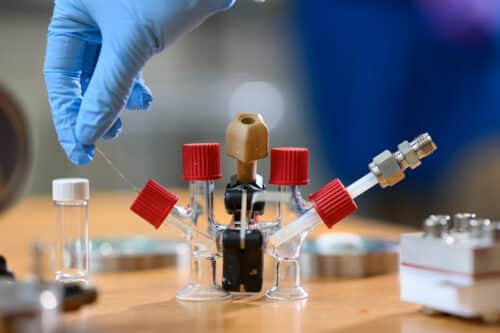
Two lab-scale prototypes were developed. The first, an H cell, has two vertical glass tubes connected by a horizontal tube with a ceramic electrolyte and porous air electrode. Liquid sodium fills one tube; air flows through the other, supplying oxygen for the reaction that consumes the sodium fuel. The second prototype uses a horizontal tray holding the electrolyte and sodium fuel, with a porous air electrode attached below to facilitate the reaction. Tests with controlled-humidity air produced over 1,500 watt-hours per kilogram at the stack level, translating to over 1,000 watt-hours at the system scale.
Using sodium hydroxide to capture carbon dioxide is often too costly due to its price. However, here it is produced as a byproduct, providing environmental benefits at no extra cost. The system uses a sealed, refillable cartridge filled with liquid sodium metal. When depleted, the cartridge is returned for refilling. Since sodium melts at 98°C—below water’s boiling point—it can be easily heated for refueling.
The initial goal is to develop a brick-sized fuel cell capable of delivering about 1,000 watt-hours of energy—enough to power a drone. This prototype would serve as a proof of concept for applications such as agriculture. The team aims to have this demonstration ready within the next year.