Helium leaks are hard to catch. This triangle-shaped device uses sound changes to find leaks and shows how it works.
Detecting helium leaks is challenging because helium is colorless, odorless, tasteless, and chemically inert. Standard gas sensors, which rely on chemical reactions, cannot detect it. Yet finding leaks is critical, as excess helium can reduce oxygen levels in enclosed spaces, posing safety risks in laboratories, industrial settings, and other confined environments.
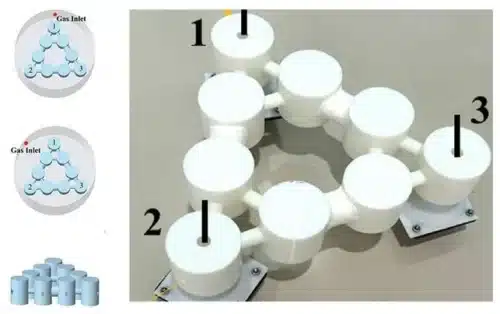
To address this, researchers at Nanjing University developed a helium-detecting device inspired by the traditional Japanese bamboo weaving technique, Kagome-biki. The device uses a triangular structure made of nine cylinders arranged in three apex-sharing sub-triangles. Microphones are placed in the corner cylinders, while small tubes between cylinders allow air to flow through. Speakers beneath the corners emit sound waves that focus on the structure’s corners.
The device detects helium by measuring changes in sound wave behavior. Sound travels at different speeds depending on the medium’s density—fast in solids, slower in air, and blocked in a vacuum. Each cylinder has a natural vibration rate, or resonant frequency, which amplifies vibrations when matched. When helium enters, it changes the gas density, altering the speed of sound waves and disrupting the resonance. Microphones detect changes in amplitude, and the resulting frequency shift reveals the presence of helium. Using this method, the device can pinpoint leaks within a 2D area by identifying which corner registers a frequency change first.
Because the sensor’s relative sensitivity remains constant and is unaffected by temperature, humidity, or other working conditions, it can operate at extremely low temperatures—something traditional gas sensors using sensitive materials struggle to achieve.
Future plans for the device include improvements to locate leaks in 3D spaces and the development of a portable version, making helium detection more practical for a wider range of environments.